
The Screenshot Problem
Here’s a scenario that plays out hundreds of times a day across the research peptide industry:
A researcher finds a vendor. The vendor claims 99% purity. The researcher asks for proof. The vendor sends a PDF. The researcher stares at it, wondering: Is this real? Was this test actually performed on this batch? Or is this the same document they send to everyone?
There’s no way to know. And that uncertainty cuts both ways.
Legitimate vendors spend hours answering the same questions, sending the same reassurances, losing sales to competitors who figured out how to make their documentation look more convincing. Meanwhile, researchers either buy based on faith or don’t buy at all.
The problem isn’t that people are dishonest. The problem is that the standard system for communicating test results (a PDF you can edit in ten seconds) was never designed to establish trust. It was designed to share information. Those are different things.
Here’s the Thing About Trust
Trust doesn’t come from better explanations. It comes from removing the need for explanations entirely.
The research peptide industry has been operating without a verification system. Every vendor has been forced to build trust from scratch, one customer at a time, using tools (PDFs, screenshots, emailed assurances) that anyone can fake.
That’s what we set out to fix.
How Verified by Vanguard Actually Works
The core principle is simple: If it’s not in the database, it’s not verified.
When we test a sample at our Olympia facility, the results get published directly to our server. Each result is tied to a unique lab ID. Anyone can look it up. Anyone can verify it. The vendor can’t edit it. We can’t edit it after publication. It just… exists, as a permanent record of what we found.
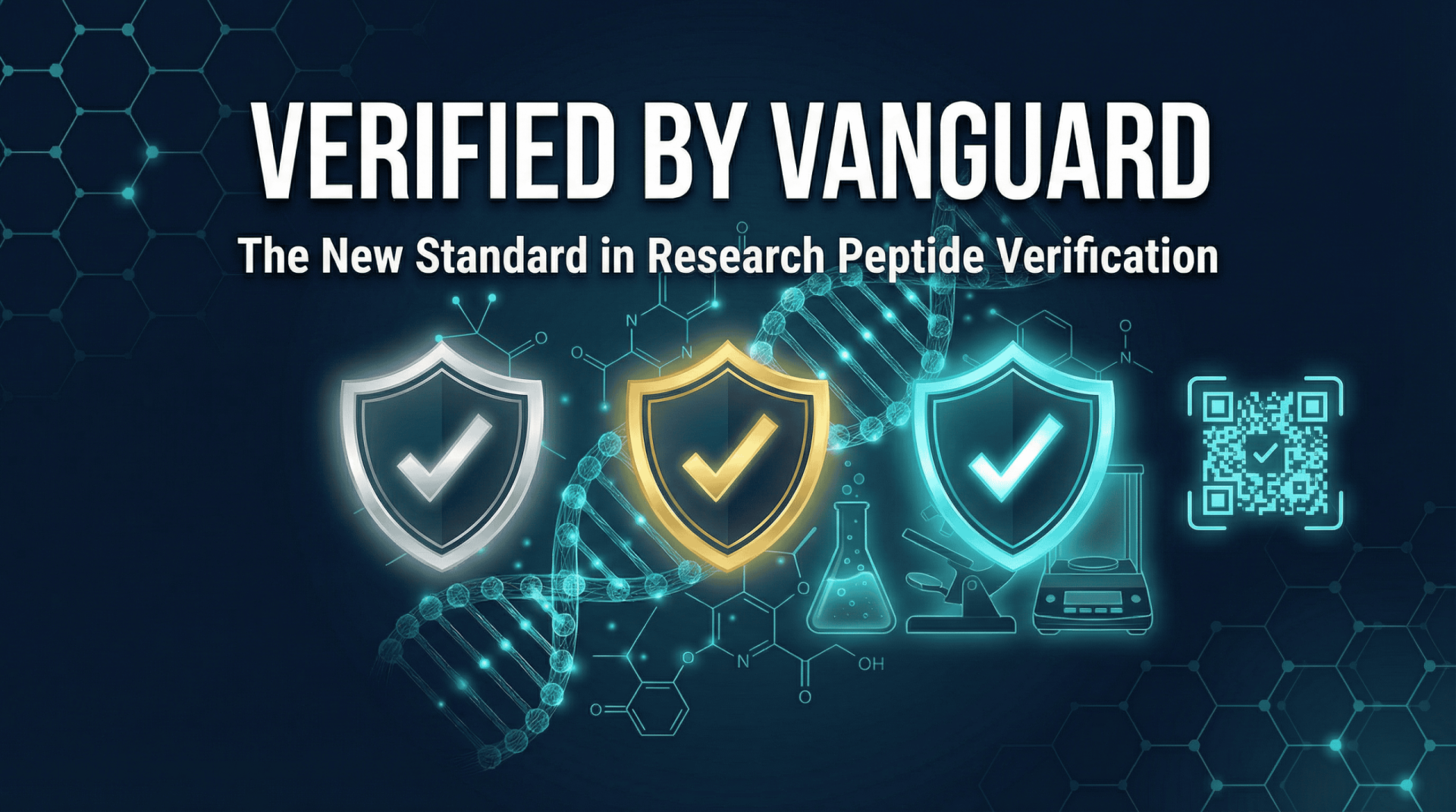
Every verified product gets a QR code. Scan it with your phone, and you’re looking at live data from our server. Not a cached copy. Not a screenshot. The actual database entry.
This changes the conversation entirely. Instead of “here’s my CoA, I promise it’s real,” it becomes “scan this and see for yourself.”
For vendors, this turns testing from a cost center into a sales tool. For researchers, it eliminates the guesswork. For everyone, it moves the industry a little closer to how things should have worked all along.
The Process
- Submit Your Sample – Ship to our Olympia, WA lab or use our pickup service. We confirm receipt within 24 hours.
- We Test (3-5 Days) – ISO/IEC 17025 accredited testing using HPLC, spectrum analysis, and contamination screening based on your chosen level.
- Results Go Live – Your CoA is published to our tamper-proof database with a unique QR code and verification link.
- Customers Verify Instantly — They scan the code or search our database. Results appear in real-time. Zero questions. Zero doubt.
The Three Verification Levels (And How to Think About Them)
Not every product needs the same level of scrutiny. A vendor establishing baseline credibility has different needs than a premium brand serving clinical researchers. We built three tiers to accommodate that reality.
Here’s how we think about each one:
Level 1: Verified (Silver) — $250/sample
“Identity Confirmed. Purity Established.”
The question this answers: Is this actually what it claims to be, and is it pure enough for research?
This is the foundation. HPLC-UV purity analysis confirms the compound meets the ≥98% standard. Spectrum analysis confirms identity. Net peptide content confirms quantity. The result gets published with a live-link QR code.
For a lot of vendors, especially those just starting to differentiate through third-party testing, this is the right starting point. It establishes that your product is genuine and meets baseline research standards. It gives your customers a way to verify that claim independently.
What’s included:
- HPLC-UV Purity Analysis (≥98% standard)
- Spectrum Analysis Identity Confirmation
- Net Peptide Content (Quantity)
- Live-Link QR Code Verification
Best for: New brands, high-volume products, or vendors entering the verified market.
Level 2: Validated (Gold): $550/sample
“Expanded quality and contamination screening.”
The question this answers: Beyond identity, purity, and quantity, has this sample also been screened for endotoxins and bioburden?
Level 2 includes the full Level 1 PQ testing scope, plus USP <85> endotoxin testing and USP <61> bioburden testing. Three vials are required per sample.
What’s included:
- All Level 1 PQ Tests
- Endotoxin Testing (standalone cost: $210)
- Bioburden USP <61> (standalone cost: $100)
- Three vials required per sample
Best for: Established brands that want expanded quality and contamination screening.
Level 3: Certified Partner (Elite): $700/sample
“Comprehensive testing with heavy metals screening.”
The question this answers: Has the sample completed the full Level 2 scope plus heavy metals screening?
Level 3 includes every Level 2 test and adds heavy metals screening for lead, mercury, arsenic, cadmium, and chromium. Four vials are required per sample.
What’s included:
- All Level 2 Tests
- Heavy Metals Screening (standalone cost: $150)
- Four vials required per sample
Best for: Premium brands requiring the most comprehensive Vanguard testing package.
What’s Different About the New CoA System
Traditional Certificates of Analysis are static. Someone creates a PDF. That PDF gets copied, emailed, posted, and re-posted. There’s no way to verify whether it’s current, whether it’s been modified, or whether it ever corresponded to a real test in the first place.
Our system works differently.
Real-time verification. When someone looks up a result, they’re querying our database directly. If a test is still in progress, they see that status. If results are published, they see the complete analysis. There’s no file to intercept or modify.
Branded reports. Your CoA displays your brand identity alongside our verification seal. Customers see both. They understand immediately that you’ve invested in proving your claims through independent testing.
No downloads, no edits. Results live on our server. They can’t be downloaded as editable files, modified, and re-uploaded. Each verification corresponds to a specific sample submitted on a specific date. The chain of custody is unbroken.
QR code access. Every verified product gets a unique code. Scan it with any smartphone camera. See results in seconds. No app, no account, no friction.
The right takeaway is this: verification should be as easy as scanning a code. If it requires explanation, if it requires trust, if it requires a customer to take your word for it, then it’s not really verification. It’s just documentation.
Why This Matters for the Industry
We’re not going to pretend the research peptide market is about to become heavily regulated. It might. It might not. That’s not really the point.
The point is that trust has become the limiting factor for legitimate vendors. You can have excellent products, excellent service, excellent prices, and still lose sales to competitors whose only advantage is that they’ve figured out how to look more trustworthy.
Independent verification flips that dynamic. It takes trust out of the equation entirely. Your product either passes testing or it doesn’t. The results are either in the database or they aren’t. Customers don’t have to believe you. They can just check.
For vendors who actually have quality products, that’s a good trade.
Getting Started
There are no long-term contracts. No minimum volumes. You pick the verification level that fits your current needs and scale up when it makes sense.
Most vendors start at Level 1 to establish baseline credentials, then move to Level 2 or Level 3 as their brand matures. You’re never locked in. You’re never paying for tests you don’t need.
Submit a sample at vanguardlabs.us, or reach out if you want to talk through which level makes sense for your products.