
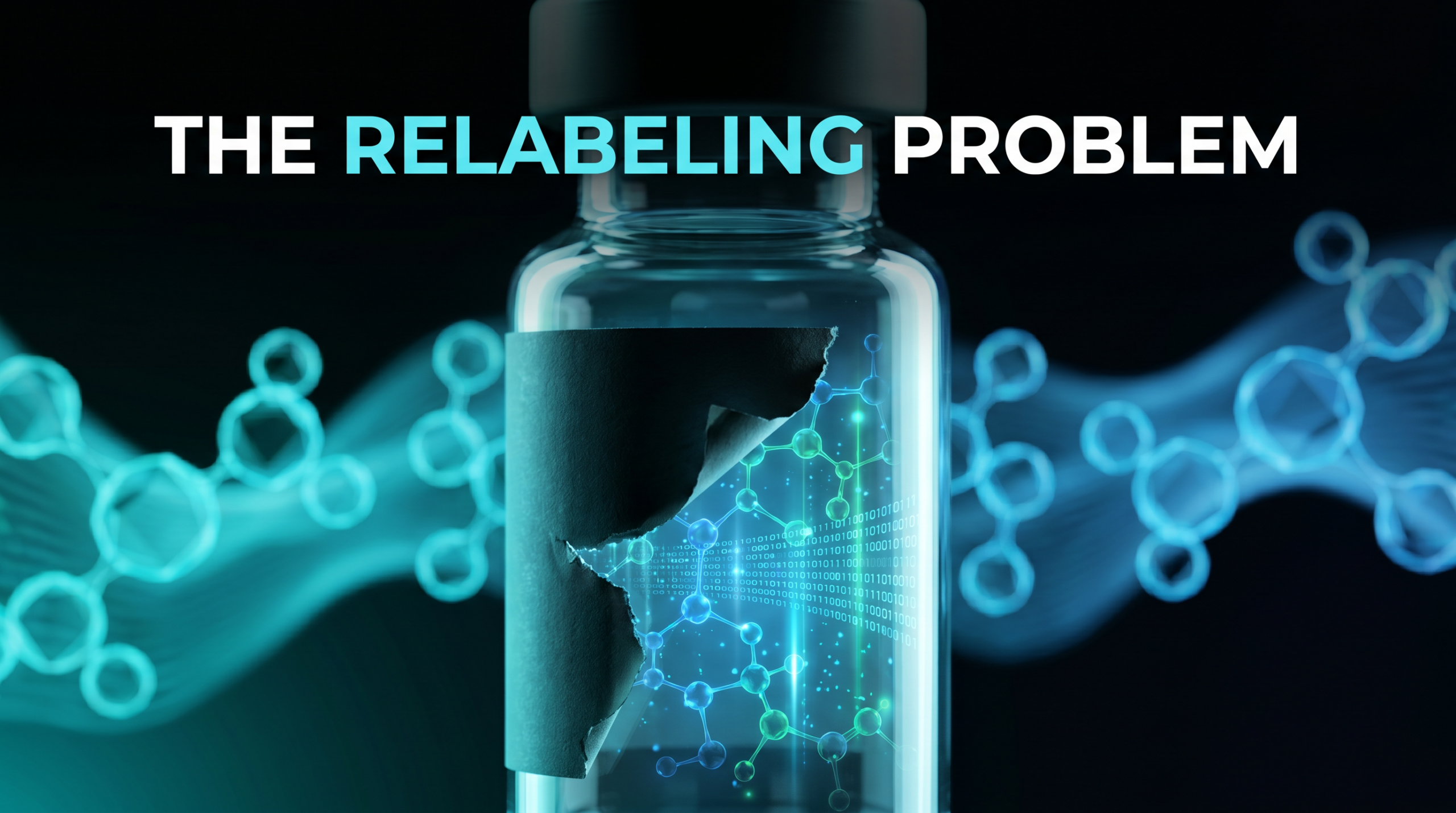
The label on a peptide vial is supposed to be a promise. It tells you what the compound is, how much is in there, and who made it. But what happens when the label is a lie?
Over the past month, two major legal actions—one by the FDA and one by the Department of Justice—have exposed a massive vulnerability in the peptide supply chain. It’s called relabeling, and it’s the process where bad actors take unverified, untested compounds and slap a new label on them to make them look legitimate.
At Vanguard Laboratory, we test thousands of peptide samples every year. We see firsthand what happens when the chemistry inside the vial doesn’t match the promises on the outside. Here is a breakdown of the relabeling problem, how it works, and why independent analytical testing is the only way to protect yourself.
The FDA’s “Trusted” List Gets Circumvented
In September 2025, the FDA implemented Import Alert 66-80, creating a “Green List” of authorized foreign facilities permitted to ship GLP-1 active pharmaceutical ingredients (APIs) like semaglutide into the United States. The goal was to secure the supply chain and protect US consumers from substandard compounds.
But on May 1, 2026, the FDA issued a warning letter to Harbin Jixianglong Biotech Co., Ltd., a Chinese manufacturer that was actually on that Green List.
According to the FDA inspectors, Harbin Jixianglong purchased semaglutide from an unauthorized supplier that was not on the Green List. Instead of running full validation, they simply repackaged the API, printed a new label identifying themselves as the manufacturer, changed the manufacturing and retest dates, and shipped it to the United States.
“FDA is concerned that identifying your firm and not the actual manufacturers may have been an attempt to circumvent safeguards associated with IA 66-80 and may pose a risk to consumers of receiving substandard GLP-1 APIs.”
This exposes a terrifying reality. Even when dealing with an FDA-vetted facility, a label can be faked. A Certificate of Analysis generated by the manufacturer is useless if the manufacturer is lying about where the product actually came from.
The Problem Reaches US Clinics
If you think relabeling only happens overseas, think again. The Department of Justice recently indicted a Utah osteopathic physician for allegedly running a massive relabeling scheme right out of his clinic.
According to the April 2026 indictment, the doctor purchased unapproved peptides—including tirzepatide, semaglutide, retatrutide, BPC-157, TB500, ipamorelin, CJC-1295, GHK, GHK-Cu, and NAD+—from China via a middleman. He bought them at a deeply discounted price, knowing they lacked proper testing.
The indictment alleges that he then made and affixed his own labels to the vials before giving them to his clinic staff. Over 200 unwitting patients received these misbranded drugs, likely assuming that because they were in a medical clinic, the products were safe, tested, and legitimate.
When a doctor in a US clinic can print labels in a back room and bypass the entire quality control process, the illusion of safety is shattered. Trusting the source is no longer enough.
The Anatomy of a Supply Chain Shortcut
How does this happen so easily? The peptide supply chain is complex, and at every step, there is a financial incentive to cut corners.
When a vendor or clinic buys cheap bulk powder from an unverified source, they are supposed to run a full panel of analytical tests. They need to verify the identity of the compound, check for synthesis byproducts, measure the exact purity, and test for dangerous contaminants like endotoxins and heavy metals.
Testing takes time and money. Relabeling takes five minutes and a label printer.
By simply printing a new label with a trusted company name and a fresh expiration date, bad actors can sell cheap, potentially dangerous powder at a massive markup. They often generate a fake Certificate of Analysis to match the fake label, creating a complete illusion of legitimacy.
The danger here is immense. You aren’t just risking an underdosed product that doesn’t work. You are risking exposure to toxic solvents left over from cheap manufacturing, dangerous heavy metals, and sterility failures that can cause severe infections.
Why Independent Testing is the Only Solution
If a Chinese manufacturer on an FDA Green List can fake a label, and a US doctor can fake a label, what can you trust?
You can trust the chemistry. Molecules don’t lie, and they don’t wear labels.
At Vanguard Laboratory, we provide ISO 17025 accredited, independent third-party testing. When a sample arrives at our facility, we ignore the label. We use advanced mass spectrometry to verify the exact molecular weight and amino acid sequence of the peptide, confirming its true identity. We use High-Performance Liquid Chromatography (HPLC) to detect impurities and synthesis byproducts. We run rigorous endotoxin and heavy metal screens to ensure safety.
A Certificate of Analysis is only valuable if it comes from an independent, third-party lab that has no financial stake in selling the product. When Vanguard issues a CoA, it means our chemists have verified the identity, purity, and safety of that specific batch using validated scientific methods.
Whether you are a compounding pharmacy trying to vet a new supplier, a clinic protecting your patients, or an individual navigating the complex peptide market, you cannot rely on the label. You have to rely on the data.
We break the chain of fraud by providing objective, unalterable data. Send us your samples, and we will give you the truth.