
Endotoxins 101: What They Are, Why They Matter, and How We Test
A plain-English guide to bacterial endotoxins, how testing works, and what your result does and does not say.
Same Peptide, Three Supply Chains: What Can the Evidence Actually Prove?
One peptide name can hide very different supply chains. We explain what RUO labels, compounded products and U.S. manufacturing records can tell you, and how our testing helps you ask better questions.
The Recall Started Before the Final Vial: What Endotoxin Testing Reveals About Injectable Quality
A September 2026 recall shows why injectable quality begins with the incoming ingredient, and why sterility and endotoxin testing answer different questions.
A Depot Is More Than Its API
Why long-acting peptide quality takes more than one number: assay, particles, residual solvents, degradation, and release behavior answer different questions.
Proof in Public: Why a Live Laboratory Record Changes Verification
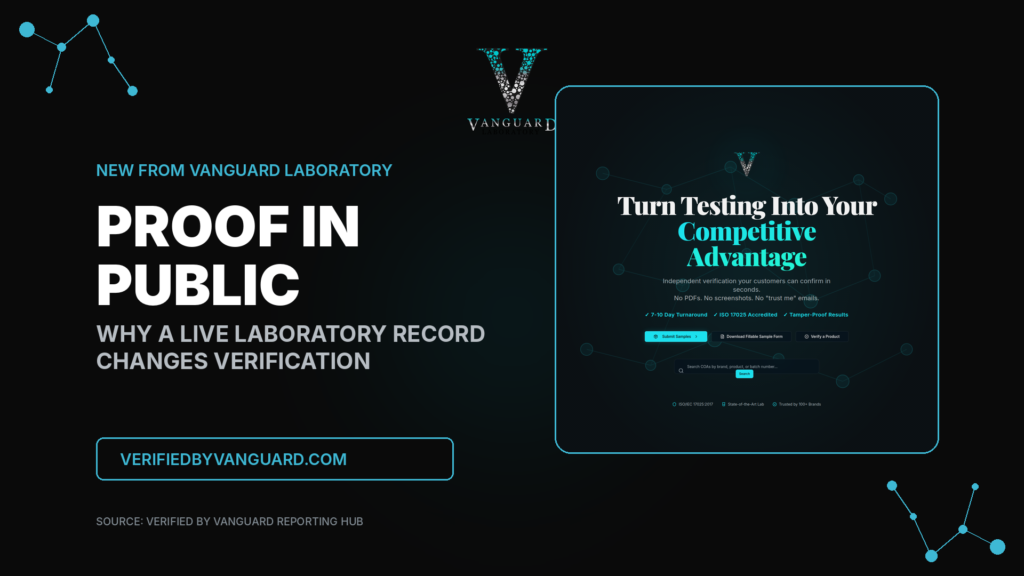
Verified by Vanguard gives brands, clinics, quality teams, and customers a direct path to search the issuing laboratory’s public record instead of relying on forwarded screenshots.
One Signal, Four Possible Causes: Why a Mass Result Is a Clue, Not a Verdict
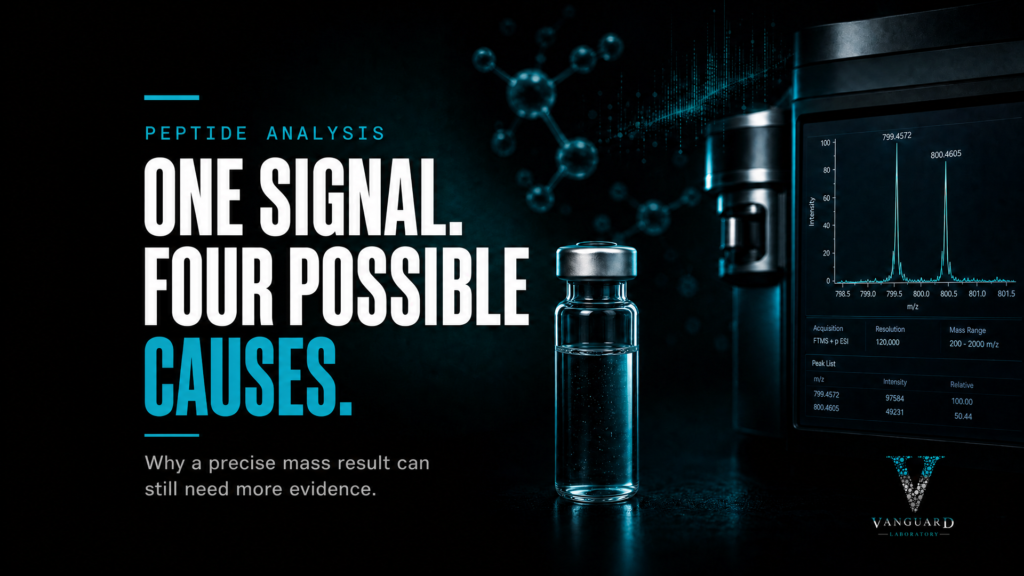
A plain-English look at why one peptide mass signal can have multiple causes, and how chromatography plus high-resolution mass spectrometry separate a clue from a defensible identification.
The Retatrutide Black Market Just Got Real: What the First Lab Data Actually Shows
Only one of eighteen black-market retatrutide vials matched its label. The first published chemical analysis explains why that number should surprise you, and what it would take to actually verify one of these vials.
The Verification Trap: When the COA Website Is Fake Too

A polished CoA, QR code, padlock, and verification page can still come from one unverified source. Learn how to authenticate a result at the issuing lab.
Sterile Is Not Safe: What the August Endotoxin Recall Reveals About Injectable Peptide Quality
A licensed compounding pharmacy recalled three lots of an injectable peptide product on August 5 after its own testing found elevated bacterial endotoxin. The vials were almost certainly sterile. Here is why those two facts coexist, and what your Certificate of Analysis needs to say about endotoxin.
The Verdict Is In: 70 Months in Federal Prison for Forged Peptide Testing
A landmark federal prosecution exposes the dangers of forged Certificates of Analysis in the research peptide market. What the 70-month prison sentence means for the industry and why independent testing is the only path forward.