
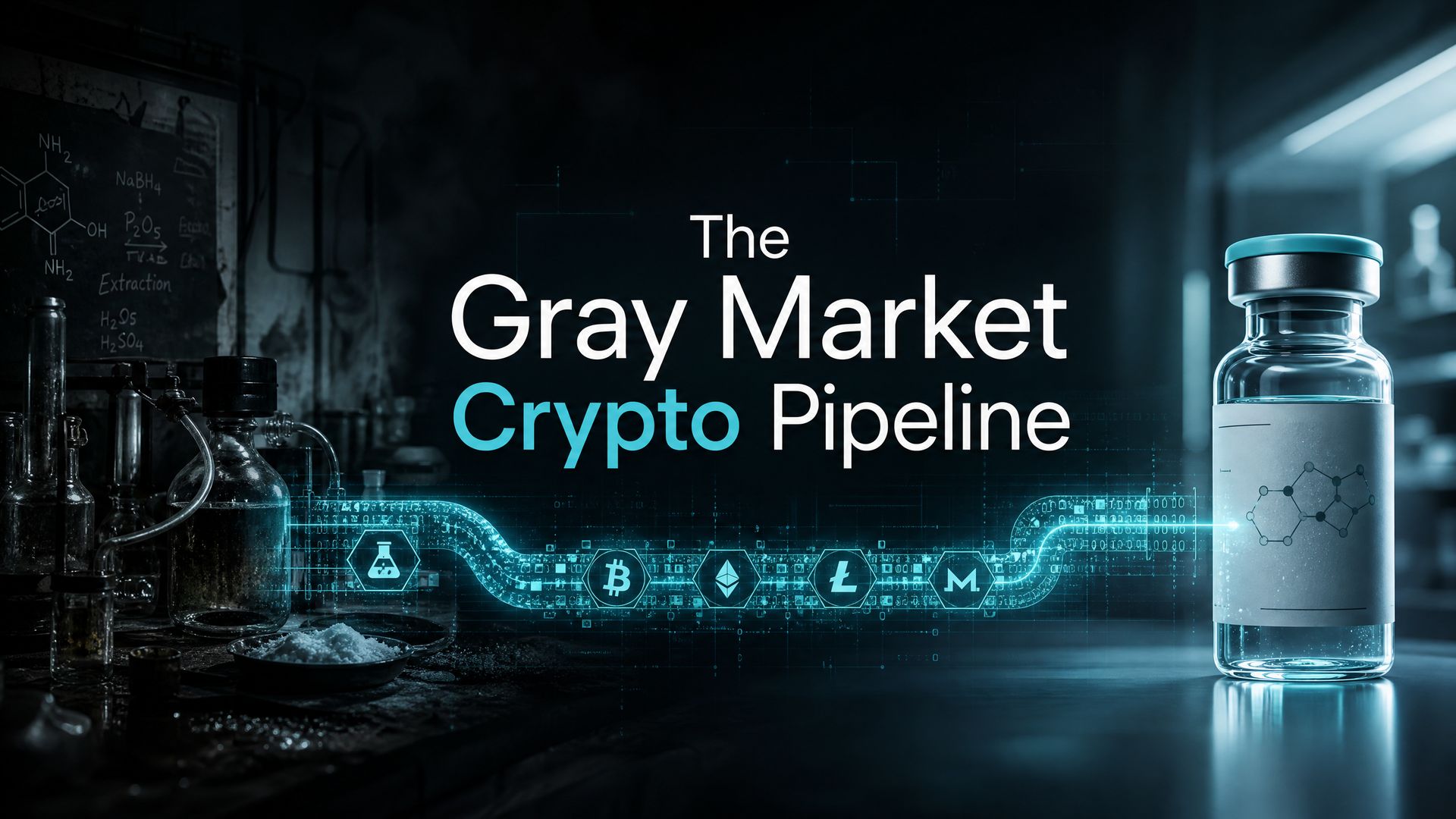
If you’ve spent any time researching peptide therapeutics online recently, you’ve likely encountered the gray market. Flashy websites, Telegram channels, and TikTok influencers offer highly coveted compounds like BPC-157, Retatrutide, and GHK-Cu at a fraction of the cost of a licensed compounding pharmacy. The vials arrive labeled “For Research Purposes Only,” bypassing the need for a prescription.
For years, this underground ecosystem operated quietly. But fueled by recent political legitimacy and a viral internet subculture obsessed with physical enhancement, the gray market has exploded.
According to a bombshell June 2026 report by blockchain analytics firm Chainalysis, the on-chain gray-market peptide industry has surged past a $100 million annual run rate. Millions of retail dollars are flooding into this space via cryptocurrency.
But as the market scales, a darker reality is emerging about exactly who is manufacturing these compounds—and what happens when independent quality control collapses.
The Fentanyl-to-Peptide Pivot
Perhaps the most alarming revelation from the on-chain data is the identity of the suppliers.
The gray market is vast, and not every overseas laboratory has illicit connections. However, Chainalysis data links some of the industry’s popular peptide vendors directly to Chinese chemical manufacturers who recently pivoted away from supplying fentanyl and amphetamine precursors to transnational drug cartels.
Facing increasing pressure from international law enforcement over the illicit drug precursor trade, these chemical laboratories realized that the peptide market offered a highly profitable, legally ambiguous alternative. By transitioning to gray-market peptides, these suppliers can sell finished products directly to the end consumer, cutting out cartel middlemen, capturing the full retail profit margin, and vastly decreasing their operational risk.
You aren’t just buying a “research chemical.” In some cases, you are buying from the exact same supply chain infrastructure that previously fueled the illicit drug trade.
Three Eras of the Gray Market
The Chainalysis report identifies three distinct phases of the gray-market peptide ecosystem:
Era 1: Underground Base (Pre-2025). The gray-market peptide ecosystem was a niche, underground space, averaging just $200,000 in monthly inflow volume. Buyers were primarily experienced biohackers with a strong harm-reduction ethos who independently verified their purchases through third-party testing.
Era 2: Political Legitimacy (Early 2025–Late 2025). The “Make America Healthy Again” (MAHA) movement and increased public attention to alternative health approaches coincided with measurable growth in the peptide market. Monthly volumes began climbing as mainstream interest grew.
Era 3: Mainstream Breakout (Late 2025–Present). The market collided with the “looksmaxxing” ecosystem on TikTok—an internet subculture hyper-fixated on maximizing physical attractiveness. Following this viral adoption, the financial average quadrupled almost overnight, surging to $9.9 million per month, with recent peak months clearing $10 million.
The Collapse of Independent Safety Testing
In the earlier eras of the peptide gray market, the community maintained a strong ethos of harm reduction. Biohackers and early adopters frequently pooled their cryptocurrency to send samples to independent laboratories—like Janoshik in Czechia—to verify the purity of the products shipped from overseas. They were willing to spend a premium to verify what they were putting into their bodies.
Today, that culture of verification has largely vanished. As retail consumers and viral “looksmaxxing” influencers flooded the space, independent product testing collapsed. According to Chainalysis, testing spend per buyer has crashed by an estimated 88%.
Instead of independently verifying the compounds, today’s buyers are blindly trusting vendor-supplied Certificates of Analysis (COAs). Suppliers frequently post passing mass and purity reports on their websites or Telegram channels. But this blind trust exposes consumers to a massive, often misunderstood risk: the gap between purity and sterility.
Purity Does Not Equal Sterility
This is the critical testing gap that vendor COAs rarely show you.
A standard purity test, such as High-Performance Liquid Chromatography (HPLC), only tells you the concentration of the peptide in the sample. It confirms that the molecule is present and measures its relative purity against other substances.
It does not test for sterility. It does not check for bacterial endotoxins. It does not screen for residual solvents like trifluoroacetic acid (TFA), dimethylformamide (DMF), or dichloromethane (DCM) that are commonly used in peptide synthesis and can accumulate in the body with repeated use.
Injecting non-sterile compounds directly into your bloodstream or subcutaneous tissue carries severe, life-threatening risks, including abscesses, systemic infections, and anaphylactic reactions.
Recently, this danger played out in real-time on a popular peptide community forum. A highly anticipated batch of Retatrutide was distributed by a trusted overseas supplier. The vendor provided a glowing COA showing excellent mass and purity. But when a cautious consumer independently submitted a vial for sterility testing, the batch failed.
The vial was “pure” peptide—and it was contaminated with bacteria.
The Residual Solvent Problem
Beyond sterility, there is another dimension of risk that vendor COAs almost never address: residual solvents.
Peptide synthesis requires powerful chemical solvents—TFA, DMF, and DCM among the most common. In a pharmaceutical manufacturing environment operating under Good Manufacturing Practice (GMP) standards, these solvents are removed through rigorous purification processes and verified through Gas Chromatography (GC) testing.
In gray-market manufacturing? There is no such guarantee. As Dr. Benjamin González noted in KevinMD, approved levels of hazardous solvents differ significantly between research-use-only (RUO) and medically graded peptides. Solvents like TFA, DMF, and DCM can acutely or chronically build up in your system with repetitive use of RUO peptides.
This is not a theoretical concern. It is a measurable, testable risk—and one that a basic purity COA will never reveal.
What the Huberman Lab Episode Confirmed
On June 1, 2026, Dr. Andrew Huberman released a comprehensive peptides episode with Dr. Abud Bakri that directly addressed sourcing and quality concerns. Key takeaways relevant to the gray market discussion:
- Gray market peptides represent a $5 to $10 billion market in the US and growing rapidly.
- Quality hierarchy: Standard pharma > quality compounders > low-quality compounders > gray market (unpredictable batch to batch) > black market (never).
- The “dirty secret” of compounding: Physicians often mark up compounded peptides significantly, but this at least keeps the supply chain within a regulated framework.
- Bakri’s key framework: Does the peptide have a known receptor? If yes, effects are more predictable. If no, proceed with extreme caution.
The episode reinforced what the Chainalysis data shows quantitatively: the gray market is enormous, growing, and increasingly populated by consumers who lack the knowledge or inclination to verify what they are injecting.
The Regulatory Landscape Is Splitting
Adding complexity to this picture is a regulatory environment moving in two directions simultaneously.
At the federal level, HHS Secretary Robert F. Kennedy Jr. announced that approximately 14 of the 19 peptides currently on the FDA’s Category 2 restricted compounding list would be moved back to Category 1—restoring the legal pathway for licensed compounding pharmacies to prepare these peptides for patients with valid prescriptions. The FDA’s Pharmacy Compounding Advisory Committee (PCAC) is scheduled to formally review them at its July 23–24, 2026 meeting.
At the state level, the opposite is happening. Alabama’s Board of Medical Examiners issued a May 26, 2026 notice prohibiting physicians from prescribing, administering, or even recommending research-grade peptides. Over a dozen states have now issued similar warnings.
The message is clear: the legitimate, regulated pathway for peptide access is expanding. But the gray market—with its unverified sourcing, collapsed testing standards, and connections to illicit supply chains—is being targeted for enforcement.
What Real Testing Looks Like
At Vanguard Laboratory, we understand that a single purity graph is not enough to guarantee safety. A true pharmaceutical-grade testing panel must interrogate the sample across multiple dimensions:
- Identity (Mass Spectrometry): Confirms the exact molecular weight and amino acid sequence. Is it actually the peptide on the label?
- Potency (HPLC): Measures the exact concentration. Is the dose accurate, or is it underdosed by 80% like many gray-market samples?
- Endotoxins (LAL/rFC): Screens for the presence of dangerous bacterial toxins that cause severe immune reactions.
- Heavy Metals (ICP-MS): Ensures the sample is free of toxic elements like lead, arsenic, and mercury.
- Sterility (USP 71): Verifies that the vial is free of viable microorganisms and safe for administration.
- Residual Solvents (GC): Confirms that hazardous synthesis solvents have been properly removed.
When the market grows faster than quality control can keep up, the consumer takes all the risk. Don’t settle for a screenshot of a purity graph on Telegram. Demand rigorous, independent, multi-dimensional testing.
Demand the Vanguard Standard.
Sources
- Chainalysis. “The $100 Million Crypto ‘Looksmaxxing’ Boom: How Chinese Cartel Suppliers Pivoted to the Gray-Market Peptide Ecosystem.” June 4, 2026.
- Huberman Lab. “Peptides: The Science, Uses & Safety | Dr. Abud Bakri.” June 1, 2026.
- Drug Topics. “Alabama Board of Medical Examiners Issues Warning of Non-FDA-Approved Peptides.” June 5, 2026.
- Pharmacy Times. “The Peptide Reclassification Everyone’s Talking About: A Pharmacist’s Take.” June 4, 2026.
- KevinMD. “Peptide regulation: 4 lanes every physician must know.” May 31, 2026.
Vanguard Laboratory is an ISO 17025 accredited analytical testing facility serving clinics, compounding pharmacies, and informed consumers. We’re ready for your samples.