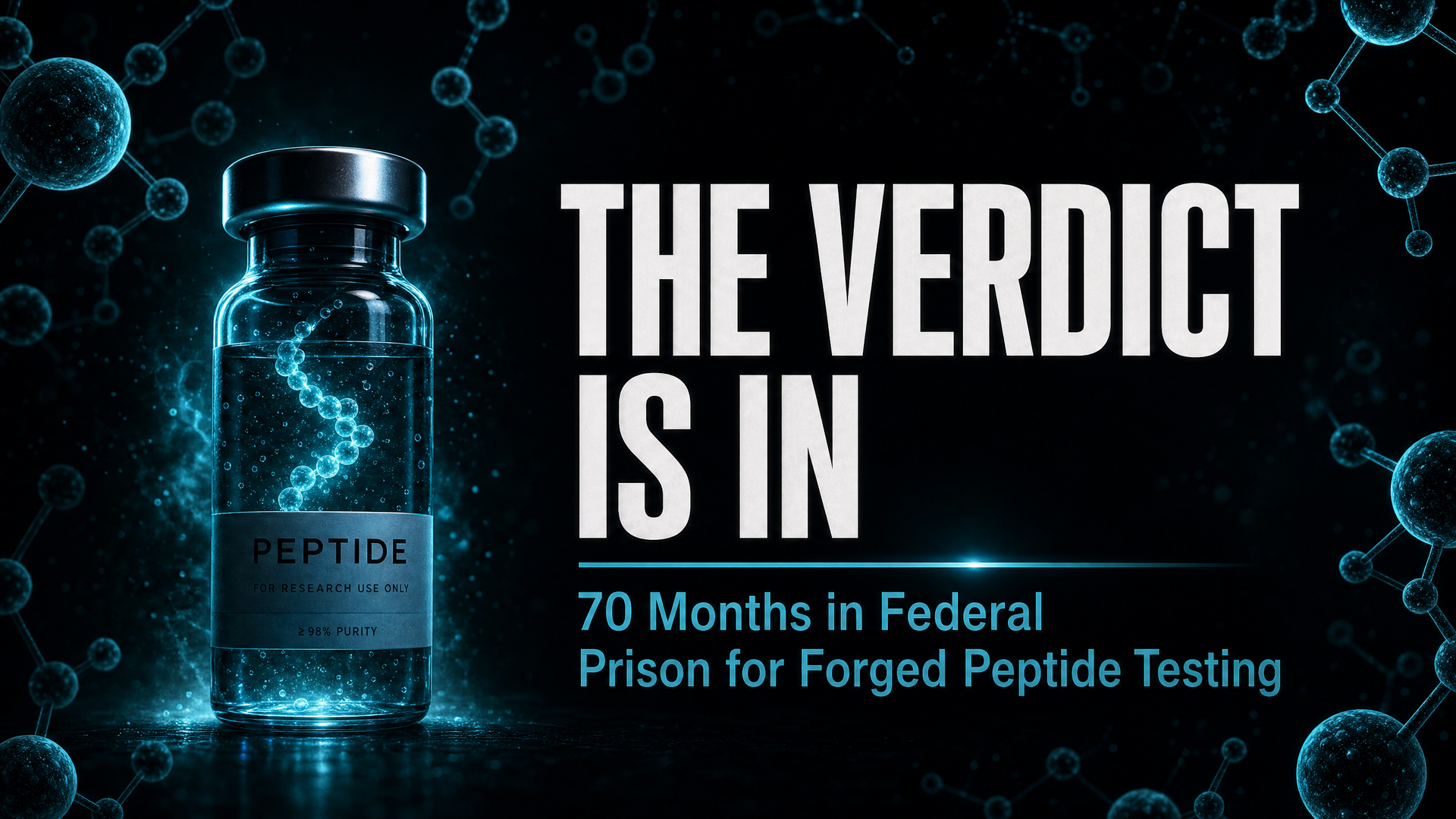
The research peptide market has operated in a legal and analytical gray zone for over a decade. But on August 3, 2026, a federal judge delivered a stark reminder that deception in this space carries profound consequences, sentencing the owner of a prominent peptide vendor to nearly six years (70 months) in federal prison.
The case, United States v. Matthew Kawa, represents a watershed moment for the peptide industry. It was not just about selling unapproved drugs—it was about the systematic deception of over 54,000 customers across all 50 states through the use of forged laboratory certificates of analysis (CoAs).
At Vanguard Laboratory, we test peptides every day. We see the gap between what a label claims and what a mass spectrometer reveals. This case perfectly illustrates why we built our lab in the first place: paper claims are cheap, but analytical truth is non-negotiable.
The Illusion of “Research Use Only”
For years, vendors have hidden behind the “Research Use Only” (RUO) disclaimer, operating under the assumption that this phrase offered a bulletproof legal shield. The Paradigm Peptides case shatters that illusion.
According to the Department of Justice, the company generated $5 million in proceeds between 2019 and 2024 by selling products they falsely marketed as high-purity, U.S.-made research chemicals. In reality, investigators found the products were imported from overseas—primarily China and India—without proper testing or quality control.
The most damaging aspect of the fraud was the use of forged laboratory certificates. A Certificate of Analysis is supposed to be the ultimate proof of identity and purity. By forging these documents, the vendor created a false sense of security for consumers who believed they were doing their due diligence.
The Real Cost of Fake Testing
When testing is faked, the consequences are measured in human harm. The court heard testimony regarding severe adverse effects suffered by customers who believed they were purchasing pure compounds. In one particularly devastating instance, a customer developed steroid-induced psychosis after using a product that was adulterated with testosterone—a controlled substance.
This highlights the critical difference between identity, purity, and safety. A forged document might claim 99% purity, but it cannot detect cross-contamination from a dirty manufacturing line. When facilities synthesize multiple compounds—including androgens, SARMs, and peptides—without rigorous cleaning validation and independent testing, the risk of cross-contamination skyrockets.
The sentencing judge described the business as leaving “an incredible trail of harm” for thousands of customers. That phrase captures the essence of what happens when analytical verification is replaced by fabricated paperwork: harm accumulates silently until it becomes undeniable.
The Closure Wave: A Changing Landscape
The sentencing of Matthew Kawa is not an isolated incident; it is the culmination of a two-year wave of vendor closures that has fundamentally reshaped the research peptide landscape.
Between March 2024 and March 2026, four major vendors exited the market:
- Paradigm Peptides (March 2024): Shut down amid the federal investigation that led to Kawa’s conviction.
- Amino Asylum (June 2025): Physically raided by federal authorities; the website was taken offline immediately with no wind-down process for customers.
- Science.bio (January 2026): Announced a voluntary, permanent closure ahead of enforcement, citing 50+ FDA warning letters industry-wide and payment processing restrictions.
- Peptide Sciences (March 2026): The largest name in the category abruptly shut down following increased federal pressure.
This closure wave demonstrates that tenure and brand recognition are no longer predictors of a vendor’s reliability or legal standing. A company that closes voluntarily and refunds customers looks identical to one that gets raided with no warning—right up until the moment it does not. The only predictor of quality is independent, verifiable analytical testing.
How to Spot a Fake CoA
At Vanguard Laboratory, we process thousands of samples and review countless CoAs. Here are the red flags our analytical chemists look for when evaluating a certificate:
- Missing Method Details: A real CoA specifies the exact analytical method used (e.g., HPLC-UV at 220nm, LC-MS/MS with ESI+). If the document simply says “purity testing” without specifying the instrument or conditions, it raises immediate concerns.
- Generic Chromatograms: Forged CoAs often use stolen or generic chromatograms that do not match the compound’s known retention time or spectral profile. Every peptide has a characteristic HPLC fingerprint—a generic peak does not prove anything.
- No Batch Traceability: If the CoA does not list a specific batch or lot number that matches the physical vial, it is meaningless. Legitimate testing ties every result to a specific sample received on a specific date.
- Unverifiable Labs: If you cannot independently contact the lab that issued the certificate to verify its authenticity, the document cannot be trusted. A real accredited laboratory will confirm or deny any CoA bearing its name.
- “100% Purity” Claims: In analytical chemistry, 100% purity is practically impossible. Even pharmaceutical-grade compounds report purity as 99.5% or 99.8%. A claim of 100.0% is often a sign of a fabricated result.
What Real Verification Looks Like
Independent analytical testing is not a single measurement—it is a multi-method approach that examines a compound from multiple angles:
- Identity (LC-MS/MS): Confirms the molecular weight and fragmentation pattern match the expected peptide sequence.
- Purity (HPLC-UV): Quantifies the percentage of the target compound relative to impurities, degradation products, and synthesis byproducts.
- Safety (ICP-MS, LAL/rFC): Screens for heavy metal contamination and bacterial endotoxins that could cause acute harm.
- Potency (Quantitative HPLC): Determines the actual amount of active peptide per vial, accounting for counterions, moisture, and residual solvents.
No single test can answer every question. That is why Vanguard Laboratory employs a comprehensive testing panel that addresses identity, purity, safety, and potency in a single submission.
The Vanguard Standard
The peptide industry is at an inflection point. As regulatory scrutiny increases and the gray market faces unprecedented enforcement, the demand for verifiable quality has never been higher.
This is why Vanguard Laboratory exists. We do not sell peptides; we provide the analytical truth about what is inside the vial. Our ISO 17025 accredited methods give patients, providers, and compounding pharmacies the objective data they need to make informed decisions.
A 70-month prison sentence sends a clear message: the era of “trust me” is over. The era of “verify it” is here.
If you need to verify the identity and purity of your peptide samples, Vanguard Laboratory is ready. Visit vanguardlaboratory.com or email [email protected] to learn about our comprehensive testing panels.
Sources
- U.S. Department of Justice, Northern District of Indiana. United States v. Matthew Kawa. August 3, 2026.
- Partnership for Safe Medicines. “Peptide vendor sentenced to six years for incredible trail of harm.” August 3, 2026.
- CBS News. “Peptides seller prison sentence unapproved drugs.” August 3, 2026.
- Best Peptide Stores. “The 2025-2026 Peptide Vendor Closure Wave, Explained.” August 6, 2026.
- Buchanan Ingersoll & Rooney. “FDA PCAC Recommends Six Peptides for the 503A Bulks List.” August 4, 2026.