
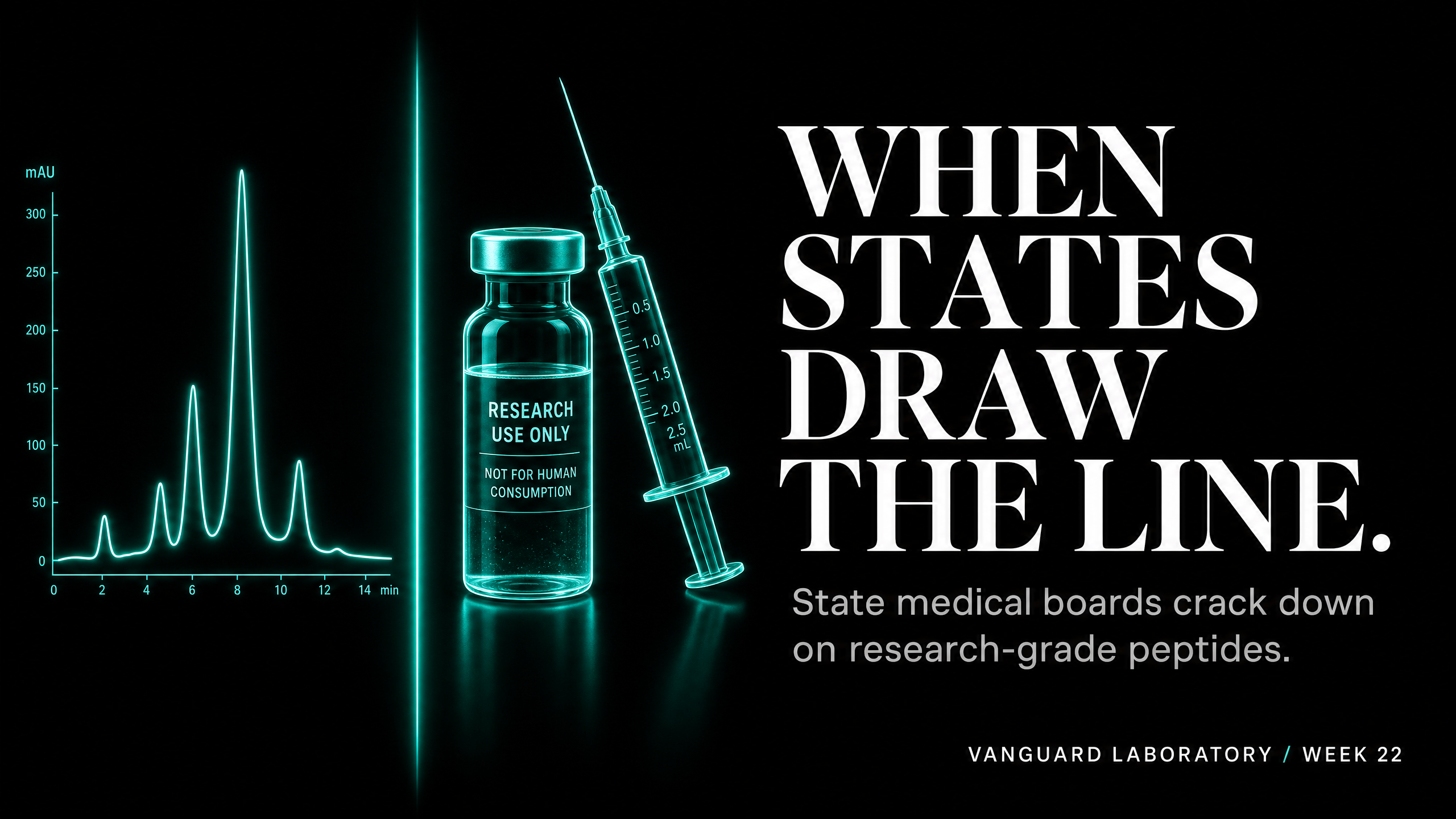
When States Draw the Line: The New Era of State-Level Peptide Enforcement and the Critical Need for Analytical Verification
Introduction: The Illusion of the Grey Market Workaround
For the past several years, the rapidly expanding peptide therapy market has operated under a fragile regulatory truce. Clinicians, medical spas, and wellness centers seeking to offer cutting-edge therapies—ranging from metabolic regulators like semaglutide and tirzepatide to tissue-repair factors like BPC-157 and TB-500—have frequently navigated a complex web of federal guidelines. Many operated under the assumption that as long as they navigated the federal “grey zones” or utilized “research-grade” materials accompanied by liability waivers, they were insulated from significant regulatory risk.
That illusion was shattered on May 26, 2026.
The Alabama State Board of Medical Examiners issued a sweeping, unequivocal alert to all licensed physicians and medical professionals across the state [1]. The directive was simple: physicians are strictly prohibited from prescribing, dispensing, administering, or recommending non-FDA-approved “research-grade” peptides [1]. This was not a warning letter from a federal agency located thousands of miles away; this was a direct action by a state licensing board policing the professional credentials of practicing physicians within its borders.
As national media outlets like CBS Mornings report that several other states are quietly preparing or executing similar crackdowns, it is clear that the regulatory battleground has shifted [3]. The era of state-level peptide enforcement has arrived. For clinics, compounding pharmacies, and healthcare providers, surviving this new regulatory landscape requires a fundamental shift from a culture of “blind trust” in suppliers to a rigorous standard of independent, analytical verification.
The Anatomy of State-Level Regulation: Why State Boards are Moving Faster than the FDA
To understand the significance of the current crackdown, one must understand the distinct roles of federal and state regulatory bodies in the United States healthcare system.
The U.S. Food and Drug Administration (FDA) is a federal agency tasked with regulating the manufacturing, labeling, marketing, and interstate distribution of food, drugs, medical devices, and cosmetics. The FDA’s primary mechanism of action is the approval of specific drug applications (NDAs or ANDAs) and the oversight of registered manufacturing facilities. While the FDA has issued numerous warnings regarding unapproved peptides—such as its high-profile reclassification of several peptides to Category 2 status—the federal process is notoriously slow, characterized by advisory committee hearings, public comment periods, and lengthy bureaucratic reviews.
In contrast, state medical and pharmacy boards regulate the practice of medicine and the professional conduct of licensed practitioners.
| Regulatory Layer | Primary Authority | Enforcement Mechanism | Speed & Flexibility |
|—|—|—|—|
| Federal (FDA) | Regulates drug manufacturing, labeling, and interstate distribution. | Import alerts, warning letters, seizure of goods, federal injunctions. | Slow; bound by administrative procedures and national rulemaking. |
| State Boards | Regulates the practice of medicine, pharmacy compounding, and professional licensing. | Audits, license suspensions, administrative fines, criminal referrals. | Rapid; can issue emergency alerts and enforce state-specific statutes immediately. |
Because state boards are charged with protecting the immediate health and safety of their local populations, they possess the authority to act swiftly. Under Alabama law, for example, the Board of Medical Examiners does not need to wait for the FDA to finalize its 503A Bulks List [1]. The board can independently evaluate whether a physician’s administration of a substance meets the state’s standard of care.
In its May 26 alert, the Alabama Board made it clear that administering “research-grade” peptides to human patients is a direct violation of state law [1]. Dr. Max Rogers, Chair of the Board, emphasized the core ethical issue:
“When a substance has not gone through FDA review, there is no reliable way to verify what it actually is, how it was manufactured or what risks it may pose. Our responsibility is to protect patients and ensure medical professionals uphold the high standards required under Alabama law.” [1]
Furthermore, the Board addressed a common legal shield used by clinics: the patient consent waiver. Many clinics require patients to sign forms acknowledging that the peptides being administered are “research-grade” or “not approved for human use.” The Board’s alert was uncompromising on this point, stating that patient consent forms or waivers describing a substance as “research-grade” do not eliminate a provider’s professional responsibilities or legal obligations [1]. Under the law, a patient cannot consent to receive substandard care, and a provider cannot contract away their professional licensing requirements.
“We Cannot Verify What’s in the Vial”: The Core Scientific Concern
If you analyze the public statements, legislative hearings, and legal filings associated with the state-level crackdowns, one specific phrase appears with remarkable frequency: the inability to verify the contents of the vial.
This is not a pedantic administrative complaint; it is a profound scientific and toxicological concern. The peptide supply chain is highly fragmented, globalized, and largely unregulated. The vast majority of “research-grade” peptides sold online or distributed to clinics are manufactured in bulk chemical synthesis facilities overseas, primarily in Asia. These facilities operate outside the purview of Current Good Manufacturing Practice (cGMP) regulations.
When a bulk powder arrives in the United States, it is frequently purchased by middlemarket vendors or compounding pharmacies who reconstitute, vial, and label the product. In many cases, these operators perform no independent testing of their own. Instead, they rely on a manufacturer-provided Certificate of Analysis (CoA).
As our laboratory team at Vanguard has documented repeatedly, these manufacturer CoAs are frequently incomplete, outdated, or outright fabricated. They often present a single High-Performance Liquid Chromatography (HPLC) chromatogram as “proof” of 99% purity, while ignoring critical safety parameters.
When a state medical board audits a clinic and asks the medical director to prove the identity, potency, and sterility of the injectable substances in their inventory, a generic PDF from an unverified overseas factory is not legally or scientifically sufficient. If the provider cannot verify the chemistry, they cannot guarantee patient safety.
The High Cost of Supply Chain Shortcuts: Purity, Contamination, and Novel Molecules
The risks of administering untested, unverified peptides are not theoretical. Recent independent scientific studies have exposed a terrifying reality within the unregulated peptide supply chain, providing regulators with the exact data they need to justify aggressive crackdowns.
The Purity and Dosage Gap
A landmark 2024 study published in the Journal of Medical Internet Research (JMIR) conducted a comprehensive quality and safety analysis of semaglutide products purchased from online grey-market vendors without a prescription [4]. The researchers utilized advanced analytical methods to measure the actual content and purity of the peptides, comparing them directly to the manufacturers’ label claims.
The findings were alarming:
– Purity Deviation: While the vendors advertised a chromatographic purity of 99%, the laboratory analysis revealed that the actual purity of the semaglutide ranged from just 7.7% to 14.37% [4]. The remaining percentage consisted of synthesis byproducts, truncated peptide sequences, and uncharacterized chemical impurities.
– Dosage Inconsistency: The measured active ingredient in the vials deviated from the labeled dosage by 28.56% to 38.69% [4]. In a clinical setting, such massive dosage variance makes precise metabolic regulation impossible and introduces a severe risk of accidental, dangerous overdosing.
The Sterility and Endotoxin Hazard
Even more concerning than the purity gap was the contamination profile. The JMIR study reported that 100% of the tested grey-market vials were contaminated with endotoxins, with levels ranging between 2.16 and 8.95 EU/mg [4].
Endotoxins are lipopolysaccharides found in the outer membrane of Gram-negative bacteria. They are released during bacterial cell lysis and are highly pyrogenic. When an endotoxin-contaminated substance is injected subcutaneously or intramuscularly, it can trigger a severe, systemic inflammatory response, resulting in high fever, chills, hemodynamic instability, and in severe cases, septic shock. In a legitimate pharmaceutical manufacturing facility, removing endotoxins requires rigorous, multi-step purification and sterile filtration protocols. In a “research-grade” chemical plant, these costly steps are routinely bypassed.
The Danger of Compounding Blends and Unstudied Reactions
In an attempt to differentiate their offerings and bypass patent restrictions, many compounding pharmacies and wellness clinics have turned to peptide “blends” or “stacks.” A common practice involves compounding tirzepatide or semaglutide with Vitamin B12 (cyanocobalamin or methylcobalamin), marketing the combination as a synergistic therapy that reduces nausea and boosts energy.
However, a March 2026 preprint study investigated the chemical stability and molecular behavior of these compounded tirzepatide-B12 blends [5]. The laboratory analysis revealed a critical, unforeseen hazard: the physical and chemical interaction between the tirzepatide peptide chain and the Vitamin B12 molecule produced a completely novel, larger hybrid molecule [5].
This novel molecule has never been characterized, studied in animal models, or evaluated in human clinical trials. Its pharmacological activity, metabolic pathway, and long-term toxicological profile are completely unknown. Furthermore, the study found massive potency inconsistencies within these compounded blends, with some samples containing as little as 43% of the active tirzepatide listed on the label [5].
When a clinic administers these uncharacterized blends, they are not practicing evidence-based medicine; they are conducting an unauthorized, uncontrolled clinical trial on their patients.
The Analytical Shield: How Advanced Laboratory Testing Verifies the Chemistry
In an environment of aggressive regulatory enforcement, “blind trust” is a liability. The only defense for a clinic, compounding pharmacy, or provider is objective, unalterable, and scientifically validated data.
At Vanguard Laboratory, we operate an ISO 17025 accredited facility designed specifically to provide this analytical shield. We do not look at the label, and we do not accept supplier promises. We analyze the raw chemistry using a multi-layered testing protocol that isolates every potential risk factor.
[Incoming Peptide Sample]

       │

       ├───► Mass Spectrometry (MS) ───────► Verifies exact molecular weight & sequence (Identity)

       │

       ├───► UHPLC-DAD ────────────────────► Detects impurities & measures exact purity % (Potency)

       │

       └───► Contaminant Screening ────────► LAL/rFC for Endotoxins & ICP-MS for Heavy Metals (Safety)
1. Identity Verification via Mass Spectrometry (MS)
Because peptides are short chains of amino acids, their identity is defined by their exact sequence and molecular weight. Standard chemical tests cannot differentiate between a highly pure vial of BPC-157 and a highly pure vial of a cheap, generic amino acid chain.
To verify identity, Vanguard utilizes advanced Mass Spectrometry. By measuring the mass-to-charge ratio of the ionized peptide molecules, our chemists can determine the exact molecular weight of the compound down to the Dalton. This allows us to confirm that the peptide in the vial matches the specific sequence of the target compound, exposing mislabeled or substituted materials instantly.
2. Potency and Purity Measurement via UHPLC-DAD
To determine the exact purity and active concentration of a peptide, we utilize Ultra High-Performance Liquid Chromatography with Diode Array Detection (UHPLC-DAD).
This method forces the reconstituted peptide sample through a specialized chromatographic column under extreme pressure. Different molecules within the sample interact with the column matrix differently, causing them to separate and exit the column at distinct times (retention times). The Diode Array Detector measures the ultraviolet absorbance of the exiting molecules, generating a chromatogram that displays the exact percentage of the target peptide relative to any impurities, synthesis byproducts, or degradation products. This is the only method that can reliably expose the purity deficits documented in grey-market studies.
3. Safety Screening for Endotoxins and Heavy Metals
To guarantee clinical safety, a peptide must be free of biological and environmental contaminants. Vanguard runs rigorous safety screens on every sample:
– Endotoxin Testing: We utilize the Limulus Amebocyte Lysate (LAL) assay and recombinant Factor C (rFC) technology to detect and quantify bacterial endotoxins, ensuring they fall safely below the strict thresholds required for injectable preparations.
– Heavy Metals Screening: Using Inductively Coupled Plasma Mass Spectrometry (ICP-MS), we screen for toxic heavy metals—including lead, arsenic, cadmium, and mercury—which can accumulate in the body over time and cause severe organ damage.
Conclusion: Elevating the Standard of Care
The state-level crackdowns initiated by the Alabama Board of Medical Examiners and echoed across the country are not the death knell of peptide therapy [1]. Rather, they are a necessary, inevitable maturation of the industry. The “Wild West” era of printing labels in back offices, relying on overseas paperwork, and administering unverified research chemicals is over.
For clinics and providers, this regulatory shift represents an opportunity to lead. By implementing a strict protocol of independent, third-party analytical testing, you do not merely achieve regulatory compliance; you elevate your standard of care. You protect your professional license, insulate your business from devastating liability, and, most importantly, deliver on the fundamental promise of medicine: first, do no harm.
At Vanguard Laboratory, we are committed to providing the scientific infrastructure that makes this transition possible. We break the chain of supply chain fraud by providing objective, unalterable, and accredited data. Don’t rely on the label. Rely on the chemistry.