L-carnitine

L-carnitine (levocarnitine) is the (R)-enantiomer of 3-hydroxy-4-(trimethylammonio)butanoate, a small zwitterionic betaine. It is made in the body and obtained from meat and dairy foods, and is also sold as salts such as the L-tartrate.

L-carnitine testing at Vanguard Laboratory: purity, quantity and identity from $250 per sample. Results in 3 to 5 business days; sterility 14 days.

Full USP monograph testing is available (USP monograph: Levocarnitine). See USP Testing.

Tests and prices

$250

Chromatographic purity and mg per unit by the method matched to the compound, identity against a reference standard. 1 unit.

$200

Chromatographic purity on bulk powder. 50 mg.

Add-on tests

Add-on testPrice
Identity and impurities
FTIR identity$90
CHNS elemental analysis (carbon, hydrogen, nitrogen, sulfur)$125
Chiral purity (where a chiral method exists; new methods quoted)$250
Water, solvents and salt form
Water content by Karl Fischer$60
Residual solvents$150
Counterions: chloride, acetate and TFA$70
Assay
Assay, % w/w (with raw powder purity; $250 together)+$50
Metals and conformity
Heavy metals: arsenic, cadmium, chromium, mercury and lead$150
Conformity: purity and quantity on more units from the same lot$100 per extra unit
Microbiology (injectables)
Endotoxin$210
Sterility or bioburden$150
Container closure integrity (CCI)$50
Screening
Fentanyl screen$50

10% off for 10 or more samples.

Need something else? We run other tests on request.

Testing notes

Table scrolls sideways on small screens.

TestPurpose for this compoundReported asSampleTurnaround
Purity and quantityPurity and quantity by HPLC. Impurity peaks are reported; identifying specific impurities, such as crotonobetaine, is a separate request.Purity, area percent, two decimals. Quantity, mg per unit, with label claim.1 sample unit; contact the laboratory about quantity for the submitted format.3 to 5 business days from receipt.
IdentityIdentity by HPLC against a reference standard. Routine HPLC does not distinguish L-carnitine from D-carnitine.Match or no match, with the basis stated.No additional sample unit.3 to 5 business days, with purity and quantity.
Water contentHygroscopic; the assay is calculated on the anhydrous basis.Water content, percent w/w.Sample quantity depends on the requested tests; contact the laboratory before shipping.3 to 5 business days from receipt.
CounterionTartrate and other salts change carnitine content per gram. Counterions are measured by ion chromatography: TFA, acetate and chloride at $70; tartrate, fumarate and other ions are quoted per project.Counterion content, percent w/w.Sample quantity depends on the requested tests; contact the laboratory before shipping.3 to 5 business days from receipt.
EndotoxinApplies to injectable levocarnitine solutions.EU per vial, numeric, or below the reporting limit. Reporting limit, dilution and the applicable limit.Sample quantity depends on the requested tests; contact the laboratory before shipping.3 to 5 business days from receipt.

L-carnitine purity and quantity are measured by HPLC in powders, capsules, injectables and other formats. Testing covers L-carnitine; D-carnitine (enantiomer) testing is not part of the service.

What these results do not show: results describe the sample tested. Purity and content do not establish biological activity, sterility, or the absence of contaminants that were not tested.
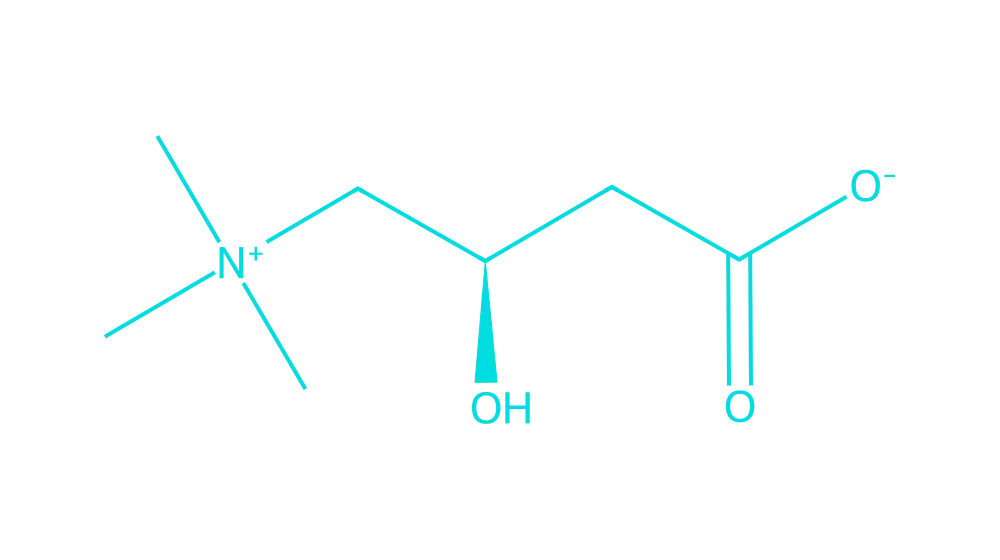
Structure

L-carnitine: 2D structure drawn from the PubChem record. Stereochemistry shown as registered.

Compound data

Classification

quaternary ammonium betaine (hydroxy acid zwitterion)

Formula

C7H15NO3

Molecular weight

161.20 g/mol (inner salt, free form)
Monoisotopic 161.1052

CAS number

541-15-1

Structure and names

Stereochemistry: (R)-configuration at C3; the (S)-enantiomer, D-carnitine, is a specified impurity

CAS note: Levocarnitine inner salt (zwitterion). L-Carnitine L-tartrate is a separate CAS, 36687-82-8 (C18H36N2O12, 472.49).

Other names: Levocarnitine (INN/USAN/USP), L-Carnitine inner salt, (R)-3-Hydroxy-4-(trimethylammonio)butanoate, (-)-Carnitine, Carnitor

PubChem CID 10917 · UNII 0G389FZZ9M[1, 6, 7]

Structural features:

  • Permanent quaternary ammonium cation plus a carboxylate, so it exists as a zwitterion
  • Single stereocenter at C3; only the (R)-form is levocarnitine
  • No aromatic ring or conjugated system, so UV absorbance is negligible
  • Dehydration gives crotonobetaine, USP levocarnitine related compound A

Research background

Active ingredient of FDA-approved Carnitor (levocarnitine) tablets, oral solution and injection and their generics[8]; also sold as a dietary supplement ingredient.

  • Per the US label, levocarnitine is required in mammalian energy metabolism and facilitates long-chain fatty acid entry into mitochondria. (approved drug label)[8]
  • Labeled for primary systemic carnitine deficiency and for secondary carnitine deficiency caused by certain inborn errors of metabolism. (approved drug label)[8]
  • Cellular uptake and renal retention depend on the OCTN2 transporter (SLC22A5); OCTN2 defects cause primary carnitine deficiency. (review)[9]

Summaries of published research, for reference only. Not a claim of safety or efficacy.

Analytical considerations

  • No UV chromophore; methods rely on derivatization, ion-exchange separation with low-UV detection, or LC-MS.[2, 10, 11]
  • Enantiomeric purity needs chiral HPLC or chiral derivatization to measure D-carnitine at 0.1-1.0% in L-carnitine.[2, 11]
  • Cis and trans crotonobetaine (related compound A) must be separated from levocarnitine.[2]
  • Hygroscopic powder; the USP assay is on the anhydrous basis, so water uptake changes reported content.[1, 8]

USP–NF monographs

Levocarnitine[1, 2]

  • Applies to: Levocarnitine bulk substance (one monograph, listed by USP under dietary supplement monographs)
  • Version: USP–NF online, 2021 version (DOI USPNF_M44700_07_01); official text dated December 1, 2021 per the USP proposal
  • Tests in the monograph: Assay by titration, NLT 97.0% and NMT 103.0% on the anhydrous basis; Identification; Enantiomeric purity by an HPLC method with derivatization. Assay limits from the USP preview; procedures as described in the USP revision proposal.
  • Proposed revisions (Pharmacopeial Forum, not yet official): Replace the titration assay with an HPLC-UV method; Replace Identification B with retention time from the new assay; Replace the derivatization enantiomeric-purity method with direct chiral HPLC; Add a Related Compounds test.

Levocarnitine Tablets[3]

  • Applies to: Levocarnitine tablets
  • Version: Revision bulletin posted July 26, 2024, official August 1, 2024
  • Tests in the monograph: Dissolution Test 2, added for FDA-approved products with different dissolution conditions and tolerances. From the official USP revision bulletin. It does not confirm every procedure in the current monograph.

Levocarnitine Oral Solution[4]

  • Applies to: A solution of levocarnitine in water with suitable antimicrobial agents
  • Version: USP–NF online, 2017 version (DOI USPNF_M44704_01_01)
  • Tests in the monograph: Definition: NLT 90.0% and NMT 110.0% of the labeled amount of levocarnitine. From the public USP preview. The complete current procedures and official date were not viewed.

Levocarnitine Injection[5]

  • Applies to: A sterile solution of levocarnitine in Water for Injection
  • Version: USP–NF online, 2017 version (DOI USPNF_M44703_03_01)
  • Tests in the monograph: Definition: NLT 90.0% and NMT 110.0% of the labeled amount of levocarnitine. From the public USP preview. The complete current procedures and official date were not viewed.

Levocarnitine Tartrate: proposed (Pharmacopeial Forum), not official.

Vanguard Laboratory:

  • Procedures offered from these monographs: Selected procedures on request, using the current official USP–NF version. Scope and sample quantity are agreed before shipping.
  • Complete monograph testing: Not offered as a package. Selected procedures are run as requested; ask the laboratory about a specific test list.

Related general chapters: 〈85〉 Bacterial Endotoxins Test, 〈71〉 Sterility Tests, 〈788〉 Particulate Matter in Injections, 〈711〉 Dissolution, 〈921〉 Water Determination. General chapters describe test methods; they are not compound-specific monographs. Chapters numbered 1000 to 1999, such as 〈1503〉, are informational.

Sample and formulation

  • Hygroscopic: ship and store tightly sealed and limit air exposure before weighing.
  • State the form claimed: levocarnitine inner salt, L-carnitine L-tartrate, or another salt. Acetyl-L-carnitine is a different compound with its own page.
  • Common formats: tablets, capsules, oral solution, injection vials and bulk powder.

Related compounds

  • Acetyl-L-carnitine: acetyl ester of L-carnitine; a chemically distinct compound
  • L-Carnitine L-tartrate: salt with L-tartaric acid; lower carnitine content per gram
  • Propionyl-L-carnitine: propionyl ester of L-carnitine
  • D-carnitine: (S)-enantiomer; a specified impurity
  • L-Lysine: biosynthetic precursor
  • L-Methionine: donor of the methyl groups in carnitine biosynthesis

References

  1. [1] United States Pharmacopeia. Levocarnitine. USP-NF. 2021. doi.org ↑
  2. [2] United States Pharmacopeia. Levocarnitine, in-process revision briefing (Pharmacopeial Forum). USP-NF. doi.org ↑
  3. [3] United States Pharmacopeia. Levocarnitine Tablets, revision bulletin. Posted July 26, 2024; official August 1, 2024. uspnf.com ↑
  4. [4] United States Pharmacopeia. Levocarnitine Oral Solution. USP-NF; 2017. DOI 10.31003/USPNF_M44704_01_01. doi.usp.org ↑
  5. [5] United States Pharmacopeia. Levocarnitine Injection. USP-NF; 2017. DOI 10.31003/USPNF_M44703_03_01. doi.usp.org ↑
  6. [6] PubChem Compound Summary: Levocarnitine, CID 10917. National Center for Biotechnology Information. pubchem.ncbi.nlm.nih.gov ↑
  7. [7] FDA Global Substance Registration System: Levocarnitine, UNII 0G389FZZ9M. precision.fda.gov ↑
  8. [8] Levocarnitine tablets and oral solution, prescribing information. ANI Pharmaceuticals. DailyMed. dailymed.nlm.nih.gov ↑
  9. [9] Longo N, Frigeni M, Pasquali M. Carnitine transport and fatty acid oxidation. Biochim Biophys Acta. 2016;1863(10):2422-35. doi.org ↑
  10. [10] Minkler PE, Stoll MS, Ingalls ST, et al. Quantification of carnitine and acylcarnitines in biological matrices by HPLC electrospray ionization-mass spectrometry. Clin Chem. 2008;54(9):1451-62. doi.org ↑
  11. [11] Freimüller S, Altorfer H. A chiral HPLC method for the determination of low amounts of D-carnitine in L-carnitine after derivatization with (+)-FLEC. J Pharm Biomed Anal. 2002;30(2):209-18. doi.org ↑

Order

Start an order online, or send the compound name and the tests you need for a quote.