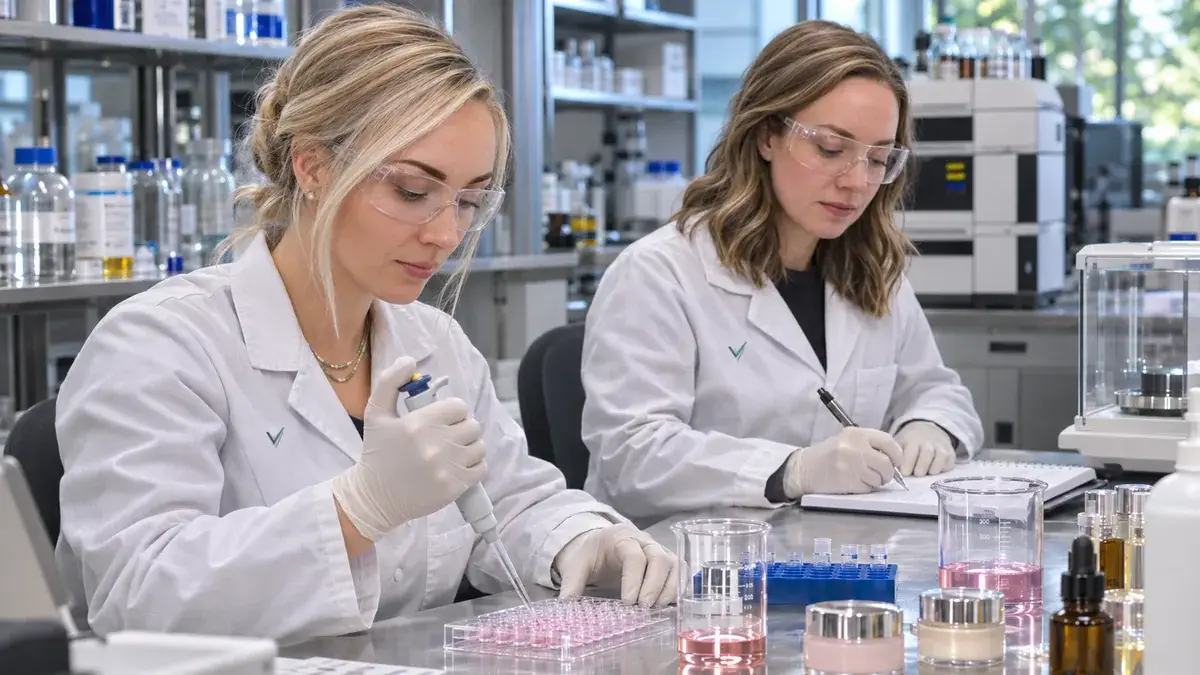
Independent testing that helps evaluate quality, consistency, and formulation performance for topical products, skincare, and cosmetic formulations. Whether you are assessing a new formula, reviewing production batches, or supporting internal quality standards, Vanguard Laboratory provides science-backed analytical testing designed to give brands and manufacturers clearer answers about their topical products.
| Test | Method | Results | Price |
|---|---|---|---|
| Microbial enumeration (USP <61>) | Total aerobic microbial count and total combined yeasts and molds, with method suitability for your product | CFU per g or mL, against your limits | Total aerobic count $28; total combined yeast and mold $28; method suitability $122 per organism (contact us for an individualized quote) |
| Specified organisms (USP <62>) | Tests for the organisms your specification names, such as Staphylococcus aureus, Pseudomonas aeruginosa, Escherichia coli and Candida albicans | Detected or not detected in the amount tested | E. coli, S. aureus, P. aeruginosa, Salmonella $28 each; Candida albicans, Clostridium, Enterobacteriaceae $33 each; method suitability $75 per organism (contact us for an individualized quote) |
| Burkholderia cepacia complex (USP <60>) | Enrichment and selective culture, often asked for water-based products | Detected or not detected in the amount tested | $33 |
| Preservative efficacy (USP <51>) | The product is inoculated with the USP challenge organisms and counted at set intervals over 28 days. See preservative effectiveness prices | Log reduction at each interval, against the USP <51> criteria for the product category | Suitability $247; 4-week $558; dual 8-week $1,108 |
| Viscosity (USP <911>, <912>) | Capillary or rotational viscometry at the temperature you set | Viscosity in mPa·s, with the test conditions | Quoted |
| pH (USP <791>) | pH meter, on the product directly or on a stated dilution | pH value at the measured temperature | $31 |
| Specific gravity (USP <841>) | Pycnometer or density meter | Specific gravity at the stated temperature | $31 |
| Active ingredient assay | HPLC against a reference standard for the active you name | Amount found, as percent of label claim or % w/w | Quoted |
| Heavy metals | ICP-MS after acid digestion, for lead, arsenic, cadmium, mercury and other elements you name | Concentration in µg/g, with the reporting limit | Quoted |
| Preservative content | HPLC or UV-Vis for common preservatives such as parabens and phenoxyethanol, against the levels in your formula | Amount found, % w/w | Quoted |
| Water activity | Water activity meter; useful for anhydrous products such as balms, sticks and powders | Water activity (aw) at the measured temperature | Quoted |
| Stability programs | Product stored at the conditions you set and tested at planned intervals, for example appearance, pH, viscosity and microbial counts | Results at each interval, against your specification | Quoted |
| Sterility (USP <71>) | Membrane filtration or direct inoculation, for products labeled sterile such as eye products | Sterile or not sterile | Quoted |
| Organism identification | MALDI-TOF mass spectrometry of an isolate from your product or from a failed test | Organism name | $300 |
| Residual solvents (USP <467>) | Headspace GC-MS for the USP <467> solvents or your list | ppm for each solvent, against the USP <467> limits | Quoted |
| Alcohol content (hand sanitizer) | Gas chromatography for ethanol or isopropyl alcohol | % v/v against the label | Quoted |
| Zinc oxide and titanium dioxide | Sunscreen actives, measured against the labeled percentage | % w/w against the label | Quoted |
| Aluminum | Aluminum in antiperspirants and other products, by ICP | % w/w or µg/g | Quoted |
| Fluoride | Fluoride in toothpaste and oral care products | ppm fluoride against the label | Quoted |
PCPC (CTFA) microbiology and PET prices are on the food, supplement and cosmetic test prices page, with the USP microbiology, physical test and allergen prices.
Need a test that is not listed? Call 360-967-7010 or email [email protected] with the product and what you need to know.
A preservative that is missing, under-dosed or breaking down is one of the most common reasons a cosmetic fails a preservative efficacy test or grows mold on a shelf. We measure preservative content in finished products and raw materials, including methylparaben, ethylparaben, propylparaben and butylparaben, phenoxyethanol, benzyl alcohol, benzoic acid and sodium benzoate, and sorbic acid and potassium sorbate. Results can be compared with the amount in your formula and with EU limits if you sell there. Preservative content is also worth checking at the start and end of a stability study, and when a preservative efficacy test fails.
Fragrances contain naturally occurring and synthetic compounds that some people are allergic to, such as limonene, linalool, citral, geraniol, eugenol and coumarin. The EU requires these to be named on the label above set levels, and recently expanded the list from 26 allergens to more than 80. MoCRA calls for fragrance allergen labeling in the US as well, once FDA issues its rule. We test fragrance oils and finished products for fragrance allergens and report each one against the labeling thresholds.
Cosmetic peptides and other cosmetic ingredients we test, each with its own page: identity, purity and quantity of the raw ingredient, and assays in finished products.
Cosmetic peptides
Other cosmetic ingredients