
A customer receives a Certificate of Analysis as a PDF.
The document is polished. The laboratory logo is present. A report number sits near the top. The analytical table is easy to read. A signature appears at the bottom.
The customer still has one unanswered question: Did the laboratory actually issue this report for this product and this batch?
That question cannot be answered by looking harder at the PDF. It requires a path back to the issuing laboratory.
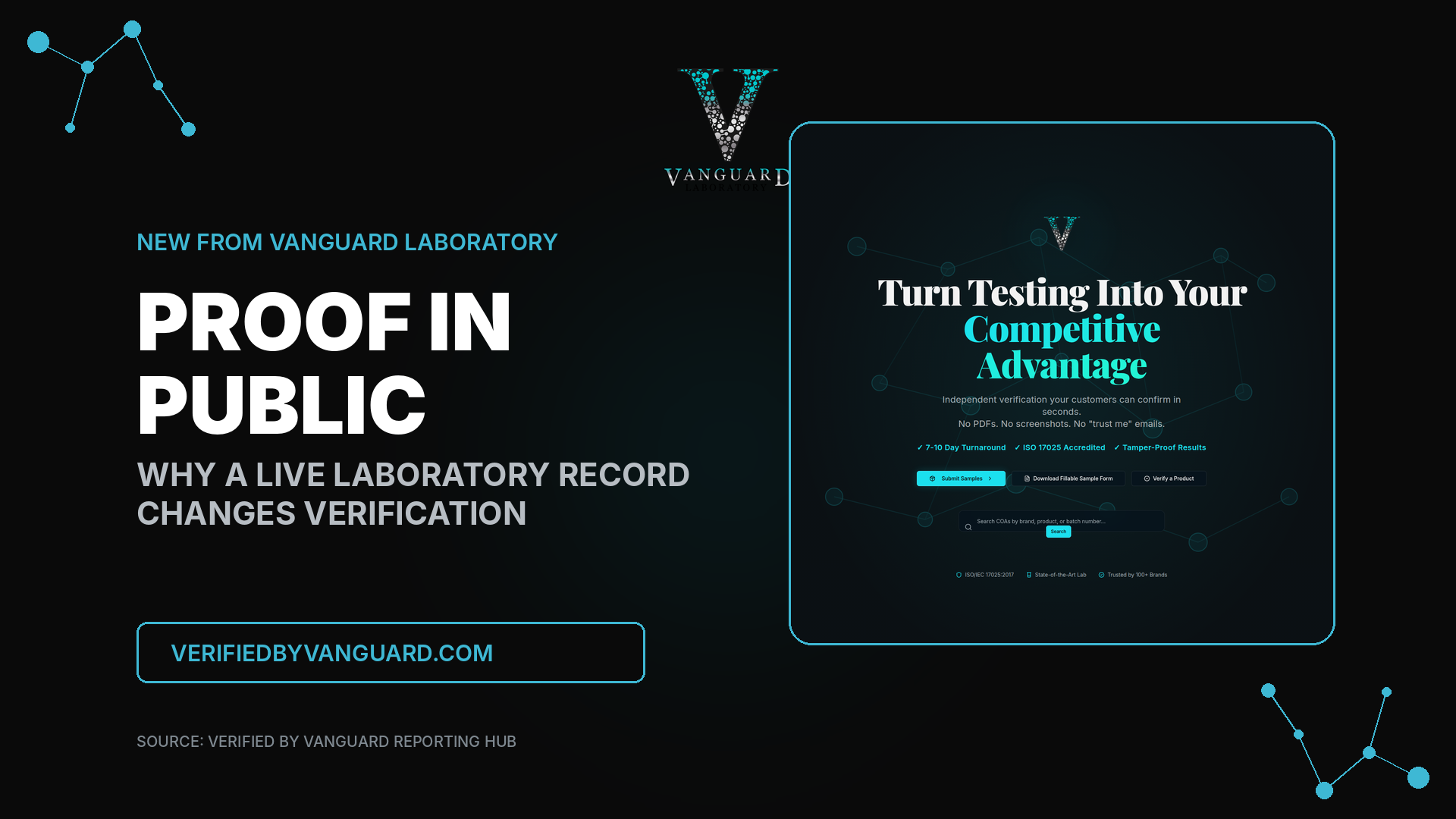
This is the problem the new Verified by Vanguard portal is designed to solve. The portal gives brands, clinics, med spas, quality teams, and customers a direct way to search Vanguard’s public reporting system by report number, product, batch, or the organization named on the certificate.1 Instead of asking a seller to provide more screenshots, the viewer can begin at the laboratory’s official domain and look for the corresponding record.
That sounds like a small change. In practice, it changes who controls the verification process.
The Difference Between Receiving Proof and Reaching the Source
A laboratory report is the visible output of a much larger process. Before the document exists, a sample has to be received, identified, prepared, analyzed, reviewed, and connected to a client-supplied product or batch identifier. The final PDF summarizes that process, but it is not the process itself.
A forwarded file places the customer at the end of a chain controlled by the sender. The sender chooses which document to share, which page to show, which link to include, and which explanation to provide. Even when everyone is acting in good faith, that workflow creates friction. The customer may have to email the seller, wait for a reply, download an attachment, and decide whether the document matches the product.
A laboratory-hosted verification portal creates a different path. The customer can leave the seller’s message, type the issuing laboratory’s known domain, search the laboratory’s public records, and compare what the laboratory shows with what the seller provided.
| Question | Forwarded PDF | Laboratory-hosted record |
|---|---|---|
| Who supplied the evidence? | Usually the seller or distributor | The issuing laboratory |
| Can the customer begin independently? | Not always | Yes, through the official laboratory domain |
| Can the record be searched? | Only if the file is already available | Yes, using the portal’s supported fields |
| Is there a direct escalation path? | Often back to the seller | Directly to the laboratory |
| Does a missing public record prove fraud? | No | No; it creates a question for the laboratory |
The point is not that every PDF is false. The point is that a PDF alone cannot authenticate itself.
How Verified by Vanguard Works
The Verified by Vanguard landing page describes a four-step sequence. A client submits a sample. Vanguard performs the selected laboratory work. The result receives a unique verification path. Publication and access depend on the client’s sharing settings. Customers can search public records or follow an authorized link.2
The public search interface supports several routes. A user can search by a complete report number, product, compound, batch, or the organization printed on the certificate. The interface also includes a public-catalog filter, a test-date filter, and a direct Contact the lab link when a report is missing.1
The most precise route is usually the complete report number. That identifier narrows the search to the laboratory record the customer is trying to authenticate. When a report has recipient-specific versions, the portal can ask the user to select the organization printed on the certificate. That extra step matters because the same underlying analytical work may be referenced by multiple organizations, while each certificate still needs to be matched to the correct recipient record.
A practical verification sequence looks like this:
| Step | Action | What it establishes |
|---|---|---|
| 1 | Type verifiedbyvanguard.com/search directly |
You began at Vanguard’s official reporting system |
| 2 | Enter the full report number when available | You narrowed the search to the relevant laboratory record |
| 3 | Match the issued-for organization, product, batch, and date | The public record corresponds to the certificate and physical lot being evaluated |
| 4 | Open the verification record | You are reviewing information served by the issuing laboratory |
| 5 | Contact Vanguard if the result is missing or inconsistent | The laboratory, not the seller, resolves the question |
The process is simple for the viewer because the quality work occurred before the search. The laboratory created and retained the record. The portal is the access layer.
A Database Miss Is a Question, Not a Verdict
Verification systems become less useful when they encourage false certainty.
A matching public record is meaningful because it gives the customer a direct laboratory source. A missing public record does not automatically mean a document is forged. A client may have chosen to keep a result private. A result may still be entering the public system. The search terms may be incomplete. The organization name may differ from the trading name the customer expects.
That is why the portal includes a direct contact route. When the search does not resolve the question, the correct next step is to ask Vanguard to confirm the report through independently obtained contact information.
The Cybersecurity and Infrastructure Security Agency recommends using known, independent contact information when a message or site may be impersonating a trusted organization.3 The same discipline applies to laboratory verification. Do not use the phone number or email address printed on the questionable document as the only source of confirmation. Start from the laboratory’s known website.
For Vanguard, the official laboratory website is vanguardlaboratory.com. The public reporting portal is verifiedbyvanguard.com. The A2LA public directory independently identifies the accredited organization as Olympic Analytical, LLC DBA Vanguard Laboratory, lists its Olympia, Washington address, and links to vanguardlaboratory.com.4
These are separate pieces of evidence that converge on the same laboratory identity.
What the Three Verification Levels Mean
The current ordering panels are Silver, Gold and Elite. Quantity is included at every level. Each panel has a defined scope:
- Silver, Level 1: Purity, quantity and identity. $250 per sample, 1 vial.
- Gold, Level 2: Silver plus endotoxins and sterility (USP 71). $550 per sample, 3 vials.
- Elite, Level 3: Gold plus heavy metals. $700 per sample, 4 vials.
Nothing else is included in any level. Fentanyl testing, TFA analysis and vial seal integrity are $50 add-ons at every level. Conformity is $100 per additional vial. Results apply to the submitted sample and do not establish suitability for human or veterinary use.
Why This Matters to Brands
Testing is often treated as a private quality-control expense. A sample is sent, a report is returned, and the PDF is stored in a folder until someone asks for it.
That model captures only part of the value.
A live verification path can turn laboratory work into a customer-facing trust asset. The brand can share one approved link instead of forwarding attachments. Sales and support teams can direct authenticity questions to the same source. Product pages can point customers toward the issuing laboratory’s public record. Quality staff can standardize how results are communicated.
The benefit is not that testing becomes marketing language. The benefit is that marketing no longer has to carry the entire trust burden.
When customers can verify independently, the brand does not need to win every conversation through persuasion. It can point to the record.
The portal’s business case is especially relevant for organizations that receive repetitive questions:
| Repeated question | Portal-supported response |
|---|---|
| “Is this report real?” | Search the issuing laboratory’s public record |
| “Does this report belong to this batch?” | Compare the report and batch identifiers |
| “Why does another seller show the same test?” | Review the recipient-specific record and issued-for organization |
| “The result is not appearing. What now?” | Contact the laboratory through the portal |
| “Which testing level was used?” | Review the program and record context rather than relying on a badge alone |
This does not eliminate the need for customer service. It gives customer service a consistent, evidence-based answer.
Why This Matters to Clinics, Med Spas, and Quality Teams
Clinics, med spas, hotel spas, and other wellness businesses often receive products from multiple distributors. Each supplier may package evidence differently. One sends a PDF. Another sends a cloud-storage link. A third places a QR code on the carton. A fourth tells the buyer to email for documentation.
Without a standard operating procedure, verification becomes inconsistent. One staff member checks the report number. Another checks only the stated result. Another assumes the presence of a laboratory logo is sufficient.
A portal-based workflow makes the internal process easier to standardize:
- Record the supplier, product, physical lot, and received documentation.
- Identify the laboratory named on the certificate.
- reach the laboratory through its independently confirmed domain.
- Search the complete report number and compare the organization, product, batch, and date.
- Save the verification link or record the laboratory’s confirmation.
- Escalate any mismatch before the product enters the organization’s normal workflow.
The portal does not make the purchasing decision for the clinic. It creates a repeatable way to authenticate one part of the evidence.
That distinction matters. Laboratory verification can confirm that Vanguard recognizes a report and that the public record matches the displayed details. It does not establish every fact about the supply chain, product handling, or intended use. Verification is a stronger starting point, not a substitute for the rest of a quality system.
The Portal Is Not the Laboratory
Digital access should never be confused with analytical competence.
The portal makes results easier to reach, but the credibility of those results still depends on the laboratory, its methods, its personnel, its quality controls, and its accredited scope. ISO explains that ISO/IEC 17025 is used by testing and calibration laboratories to demonstrate competence and the ability to generate valid results.5 A2LA’s public directory provides an independent place to confirm Vanguard’s accredited identity and certificate information.4
The relationship is straightforward:
- The laboratory performs and reviews the analytical work.
- The quality system connects the work to a report.
- The portal lets an authorized public record be found and shared.
A sleek interface cannot replace competent testing. Competent testing that cannot be authenticated creates a communication problem. The system needs both.
From “Trust Me” to “Check Here”
The phrase “trust us” asks the customer to evaluate confidence.
The phrase “check here” gives the customer a procedure.
That is the practical shift represented by Verified by Vanguard. The customer can begin at the official laboratory domain, search the laboratory’s public system, compare the record with the document and lot, and contact the laboratory when the result is missing or inconsistent.
For brands, this can reduce repeated authenticity explanations and make the value of testing easier to share. For clinics and quality teams, it can create a consistent verification step. For customers, it can replace a chain of forwarded screenshots with direct access to the source.
The report still matters. The testing still matters. The portal does not diminish either one.
It connects them to the person who needs to decide whether the evidence is real.
Explore the portal: https://verifiedbyvanguard.com/
Search public records: https://verifiedbyvanguard.com/search
Contact Vanguard Laboratory: https://vanguardlaboratory.com/contact/