
Kava: Piper methysticum root.
Kava testing at Vanguard Laboratory: identity, purity and quantity $250 per sample, with results in 3 to 5 business days.
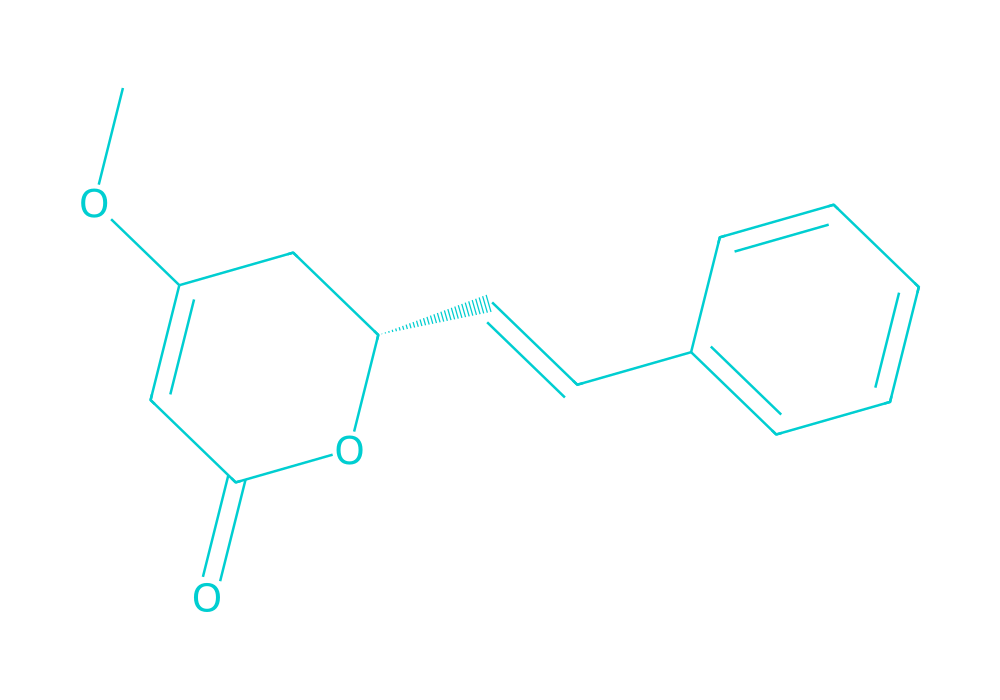
Marker compound: 2D structure drawn from the PubChem record (CID 5281565).
Piper methysticum root
the six major kavalactones: kavain, dihydrokavain, methysticin, dihydromethysticin, yangonin and desmethoxyyangonin
total or named markers, as your specification states
botanical ingredient
Marker compounds: the six major kavalactones: kavain, dihydrokavain, methysticin, dihydromethysticin, yangonin and desmethoxyyangonin.
Kava is extracted and its marker compounds separated by reversed-phase HPLC with UV detection, with LC-MS identity of the markers where needed. Marker compounds are measured against reference standards, $250 per sample with results in 3 to 5 business days. Tell us the basis your specification uses: a total, named markers or a single compound.
$250
Chromatographic purity and mg per unit by the method matched to the compound, identity against a reference standard. 1 unit.
| Add-on test | Price |
|---|---|
| Identity and impurities | |
| FTIR identity | $90 |
| CHNS elemental analysis (carbon, hydrogen, nitrogen, sulfur) | $125 |
| Chiral purity (where a chiral method exists; new methods quoted) | $250 |
| Water, solvents and salt form | |
| Water content by Karl Fischer | $60 |
| Residual solvents | $150 |
| Counterions: chloride, acetate and TFA | $70 |
| Assay | |
| Assay, % w/w (with raw powder purity; $250 together) | +$50 |
| Metals and conformity | |
| Heavy metals: arsenic, cadmium, chromium, mercury and lead | $150 |
| Conformity: purity and quantity on more units from the same lot | $100 per extra unit |
10% off for 10 or more samples.
Need something else? Other tests are available on request.
Purity and quantity is $250 per sample (1 unit) and raw powder purity is $200 for 50 mg, with results in 3 to 5 business days. Send the material sealed and labeled, with the label claim and the form it contains.
HPLC measures the six major kavalactones against reference standards, reported individually and as a total.
Yes. Capsules, powders, gummies and liquids are measured with sample preparation matched to the product, and reported in mg per serving or % w/w against the label.
The USP Herbal Medicines Compendium monograph covers identity by HPTLC fingerprint and content of the six major kavalactones (methysticin, dihydromethysticin, kavain, dihydrokavain, yangonin and desmethoxyyangonin) by HPLC.
Forms and titles: Piper methysticum Root and Rhizome; Piper methysticum Root and Rhizome Powder; Piper methysticum Rootstock; Piper methysticum Rootstock Dry Extract; Piper methysticum Rootstock Powder
No. The $250 test covers identity, purity and quantity by HPLC-UV measurement of six major kavalactones, with LC-MS identity. Full testing to the USP Herbal Medicines Compendium monograph for Piper methysticum Root and Rhizome is available and quoted.
Kava’s composition is described by six major kavalactones, and the monograph sums all six. Their relative ratio, often called the chemotype, differs between cultivars.
Stems, leaves and peelings have a different kavalactone pattern and tend to be higher in flavokavains. Comparing the profile with root reference material helps flag these materials.
Yangonin and desmethoxyyangonin can isomerize under light in solution, so standards and samples are protected from light during analysis.
Send the product name, the form of the ingredient and the label claim for a quote, or submit a sample with the sample form.