
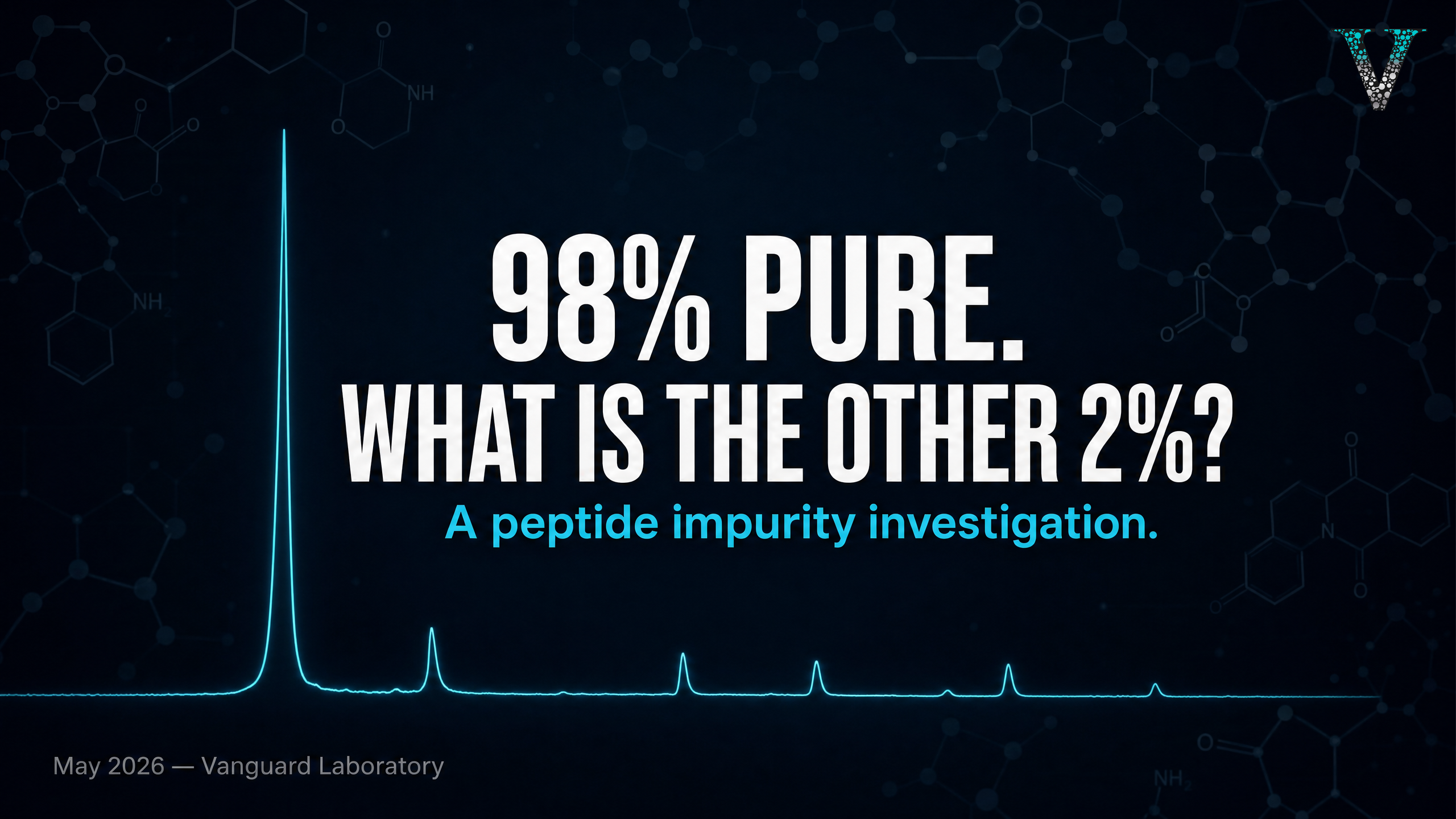
A purity percentage describes one chromatogram. This guide explains what that number measures, what it leaves out, and which tests answer the questions it cannot.
What “98% pure” measures
Most peptide certificates report purity from high-performance liquid chromatography with UV detection (HPLC-UV). The method separates the dissolved sample into components, and each component the detector sees appears as a peak, unless two components leave the column together and share one peak. The purity figure is usually the area of the main peak divided by the total area of the peaks the method integrates.
So 98% means the main peak accounts for 98% of the UV signal from the peaks that were counted, under that method’s column, wavelength and integration settings. It is a relative number. It does not say what the other peaks are, and it does not say how much peptide is in the vial.
The other 2% of the chromatogram
The smaller peaks are usually peptide-related impurities, formed during synthesis or purification or later during storage. The EMA guideline on synthetic peptides describes the main types [1]:
- Deletion sequences, where one or more amino acids are missing because a coupling or deprotection step was incomplete.
- Truncated sequences, where the chain stopped short of its full length.
- Insertion sequences, where an extra amino acid was added.
- Degradation products, for example oxidation of methionine or cysteine, deamidation, hydrolysis and isomerization.
- Diastereomers, where an amino acid has the wrong configuration, which can need a dedicated method to control.
These differ in mass in different ways. Oxidation of methionine adds an oxygen atom, so the oxidized peptide is 16 Da heavier than the intended one. A diastereomer has exactly the same mass as the intended peptide but is a different compound. Neither difference can be read from a peak’s area. An impurity is identified by comparison with a characterized reference or by an orthogonal technique such as mass spectrometry, as appropriate, and some impurities need a different separation to resolve them at all [1].
What the percentage leaves out
Some components of a peptide powder never appear in the purity calculation, because they give no UV peak under the method or are not counted as peptide peaks:
- Counterions. Synthetic peptides are usually supplied as salts. Acetate is common, and trifluoroacetate or chloride are also possible [1]. The counterion adds mass to the powder but is not part of the peptide peak area.
- Water. Peptides are often hygroscopic, so a lyophilized powder holds water that adds mass and has no peak [1].
- Residual solvents, which the peptide method does not measure even when they absorb UV; they are tested separately by gas chromatography. Excipients such as mannitol, which give little or no UV signal.
This is why a powder can read 98% by HPLC area and still contain noticeably less than its weight in peptide. Purity and content are separate results. Content comes from a quantitative assay against a reference standard, read together with the counterion and water results. Our article Same Name, Different Chemical walks through that calculation.
Two vials with the same number
Picture two vials of the same peptide, each with a certificate showing 98% HPLC purity. In the first, most of the remaining peak area is a truncated sequence. In the second, it is an oxidized form of the peptide. The headline number is the same, but the impurity is not, and only identification work can tell the two apart. In both vials, how much peptide is actually present is a separate question that the purity figure does not answer.
How medicines regulators treat peptide impurities
For medicines, regulators expect peptide-related impurities to be reported, identified and qualified above set thresholds. In the EU, the EMA guideline on synthetic peptides applies the thresholds in the European Pharmacopoeia general monograph Substances for Pharmaceutical Use, and it expects additional methods where one method cannot separate every impurity [1]. These rules govern drug applications. They show what “identified” means in practice; a certificate for a research material does not meet them just by reporting a purity figure.
Which test answers which question
| Question | Test that answers it |
|---|---|
| How much of the UV signal is the main peak? | HPLC purity (area percent) |
| Is the main peak the expected peptide? | Retention time and UV spectrum against a reference, included in routine peptide testing; mass confirmation by LC-MS, quoted separately |
| How much peptide is in the vial? | Quantitative HPLC assay against a reference standard |
| How much trifluoroacetate or acetate is present? | Ion chromatography for trifluoroacetate and acetate; other ions are quoted per project |
| How much water is present? | Karl Fischer titration |
| Are bacterial endotoxins present? | Bacterial endotoxin test (LAL) under USP <85> |
| Did the units tested show microbial growth? | Sterility testing of the submitted units under USP <71>, or rapid sterility testing; the result covers the units tested |
| Are heavy metals or residual solvents present? | ICP-MS for elements; headspace gas chromatography for solvents |
Which of these a sample needs depends on what the material is and how the result will be used. Our Peptide Blends 101 and One Signal, Four Possible Causes articles cover identity and mass results in more detail.
Testing peptides at Vanguard Laboratory
Vanguard Laboratory tests peptide samples for purity, quantity and identity, with endotoxin, sterility, heavy metals, residual solvents and counterion analysis available as separate tests. Each report names the methods used and applies to the sample submitted. A purity result is one line of evidence about that sample; it is not a statement that a product is safe for any use. Current tests and packages are on the peptide testing page, and testing can be ordered at verifiedbyvanguard.com/order.
References
- [1] European Medicines Agency. Guideline on the Development and Manufacture of Synthetic Peptides. EMA/CHMP/CVMP/QWP/367182/2025. CHMP adoption 1 December 2025, CVMP adoption 4 December 2025, effective 1 June 2026. https://www.ema.europa.eu/en/documents/scientific-guideline/guideline-development-manufacture-synthetic-peptides_en.pdf