
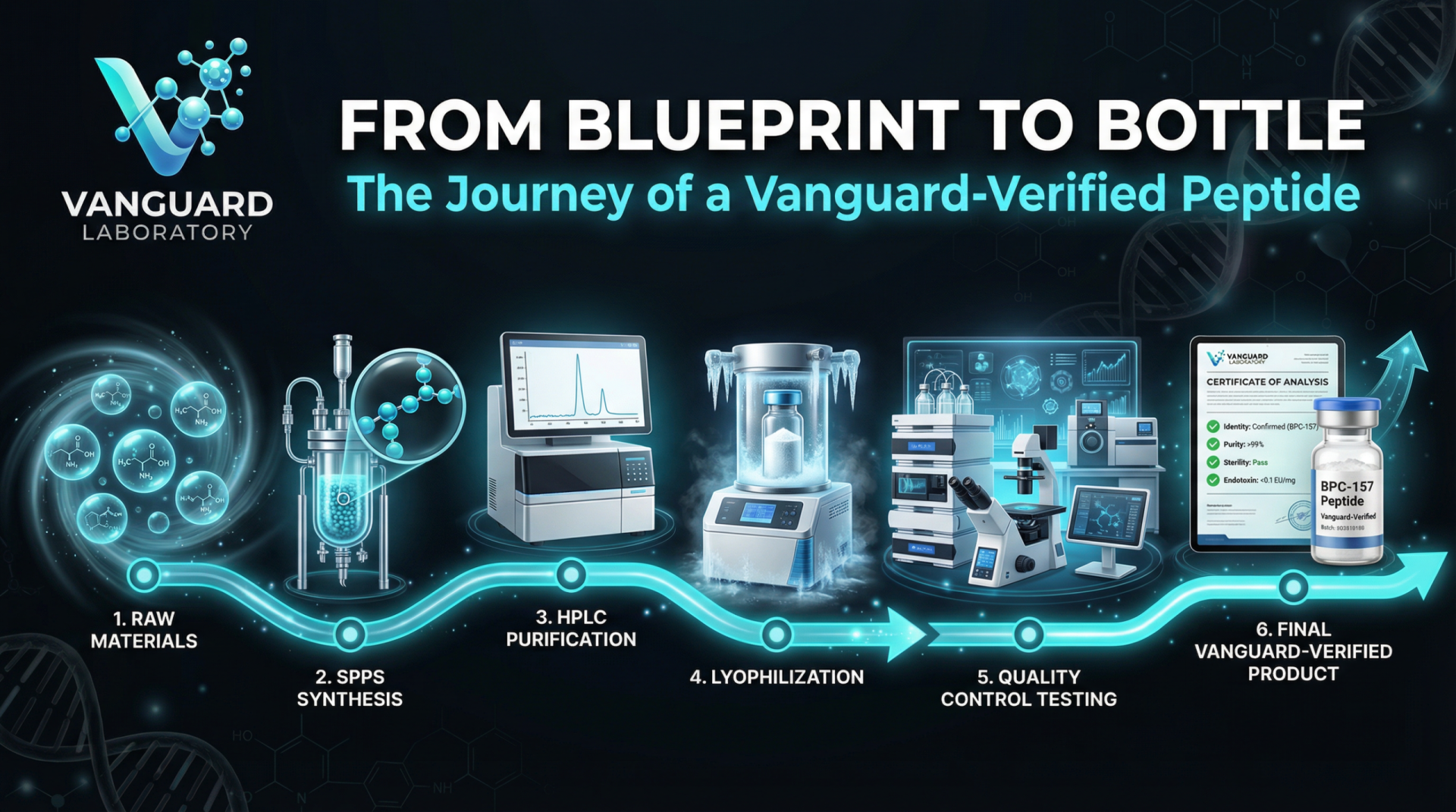
In the world of scientific research, the quality of your materials is paramount. A peptide is not just a simple compound; it is a precision-engineered tool. But have you ever wondered how these tools are made? What does it take to go from a chemical blueprint to a stable, verified product ready for the lab?
This is the story of a peptide’s journey, a multi-stage process of synthesis, purification, and rigorous testing. We will follow the path of a well-known peptide, BPC-157, to illustrate how a raw concept is transformed into a trusted research compound, with independent verification from a third-party lab like Vanguard Laboratory as the final, critical step.
The Building Blocks – Sourcing Raw Materials
Every great structure begins with quality materials. For peptides, these materials are amino acids. BPC-157, a pentadecapeptide, is composed of a precise sequence of 15 amino acids: Gly-Glu-Pro-Pro-Pro-Gly-Lys-Pro-Ala-Asp-Asp-Ala-Gly-Leu-Val.
These are not simply mixed together. Each amino acid is a distinct raw material that must be sourced in its purest, pharmaceutical-grade form. The production of these amino acids is a science in itself, often involving processes like:
- Fermentation: Using specific microbial cultures to produce high-purity amino acids.
- Enzymatic Synthesis: Employing enzymes to catalyze the creation of specific amino acids.
- Chemical Synthesis: Building amino acids from precursor molecules.
For a peptide like BPC-157, the manufacturer must procure the 8 different amino acids that make up its 15 residues (glycine, glutamic acid, proline, lysine, alanine, aspartic acid, leucine and valine), each meeting strict purity standards before the synthesis process can even begin. The integrity of the final product depends entirely on the quality of these initial building blocks.
The Blueprint – Solid Phase Peptide Synthesis (SPPS)
With the raw materials in hand, the next step is to assemble them in the correct order. This is done using a method called Solid Phase Peptide Synthesis (SPPS), a Nobel Prize-winning technology that revolutionized peptide manufacturing.
Here’s a simplified look at the process:
- Anchoring: The first amino acid in the sequence (for BPC-157, that’s Valine) is anchored to a solid resin bead. This provides a stable foundation to build upon.
- Coupling: The next amino acid in the sequence is chemically “coupled” or bonded to the first one. This is a precision step, repeated for every amino acid.
- Protecting Groups: To ensure the amino acids only connect in the correct sequence, “protecting groups” are used to block other reactive parts of the molecule. The temporary group on the amino end is removed after each successful coupling to allow the next amino acid to be added; the side-chain protecting groups stay on until the final cleavage step.
- Chain Elongation: This process is repeated 14 times for BPC-157, adding one amino acid at a time, until the full 15-amino acid chain is complete.
- Cleavage: Once the synthesis is finished, the completed peptide is cleaved from the resin bead.
At this stage, we have a “crude” peptide. It contains the full-length BPC-157, but it is also mixed with impurities like truncated sequences, leftover chemicals, and failed sequences.
The Refinement – Purification via HPLC
The crude peptide mixture is not yet ready for use. It must undergo a rigorous purification process to isolate the desired full-length peptide from all the impurities. The gold standard for this is High-Performance Liquid Chromatography (HPLC).
In HPLC, the crude mixture is passed through a column under high pressure. Different components of the mixture travel through the column at different speeds based on their chemical properties. This allows for the separation of the full-length BPC-157 from all other unwanted substances.
The result is a highly purified peptide solution, but it is still in a liquid form, which is not ideal for long-term stability.
The Preservation – Lyophilization
To create a stable, shippable, and storable product, the purified peptide solution is lyophilized, or freeze-dried. This process removes the water without damaging the delicate peptide structure.
- Freezing: The peptide solution is frozen to a solid state.
- Primary Drying (Sublimation): Under a vacuum, the frozen solvent is turned directly into a vapor and removed, bypassing the liquid phase.
- Secondary Drying: Any remaining moisture is removed, leaving a dry, stable powder.
One of the key advantages of BPC-157 is that in its lyophilized form, it is stable at room temperature. This is a crucial distinction, as many other peptides require a strict cold chain for shipping and storage. For BPC-157, the cold chain only becomes a factor after it has been reconstituted into a liquid.
The Verification – Why Third-Party Testing Matters
The manufacturer has now produced a lyophilized peptide. They will perform their own internal quality control, but how can a customer be truly confident in the product’s purity, quantity, and safety?
This is where independent, third-party testing comes in. It is the most critical step for ensuring transparency and trust.
A third-party lab like Vanguard Laboratory acts as an unbiased quality gatekeeper. We receive the final product from the manufacturer or reseller then subject it to a battery of tests to verify that it meets the highest standards. This independent verification is your assurance that what’s on the label is what’s in the vial.
The Vanguard Standard – The Four Pillars of Testing
At Vanguard, we can perform a comprehensive suite of tests on the sample you submit; which tests are run depends on the package you order. Here are the four main pillars of our verification process:
- Purity, Quantity and Identity: Using HPLC, we measure the purity of the peptide relative to its impurities and the quantity of peptide in the vial compared with the label. We confirm its identity by retention time and UV spectrum against a reference standard, with LC-MS for specific compounds or on request.
- Endotoxin Testing: Endotoxins are harmful bacterial toxins that can be present if manufacturing standards are not sterile. We measure the endotoxin level and report it so it can be compared with the applicable limit.
- Heavy Metals Testing: We screen for the presence of toxic heavy metals like lead, arsenic, mercury, and cadmium, which can be introduced from raw materials or equipment.
- Sterility Testing (USP 71): This test checks for the presence of any living microorganisms, such as bacteria or fungi. A passing result means no growth was detected in the units tested; it does not by itself make a product safe.
The Guarantee – The Certificate of Analysis (CoA)
When testing is complete, we issue a Certificate of Analysis (CoA) for the sample and the tests ordered, whatever the results. It records what was measured: the detailed results of our independent tests, such as the peptide’s identity, purity and quantity and any contaminant tests that were ordered.
The CoA is not just a piece of paper; it is the final record in a long and complex journey. It is the culmination of sourcing the best raw materials, precision synthesis, rigorous purification, and unbiased, third-party verification.
From a chemical blueprint to a Vanguard-verified bottle, this journey is what ensures that the tools you use in your research are reliable, safe, and of the highest possible quality. Because at the end of the day, your results depend on it.